


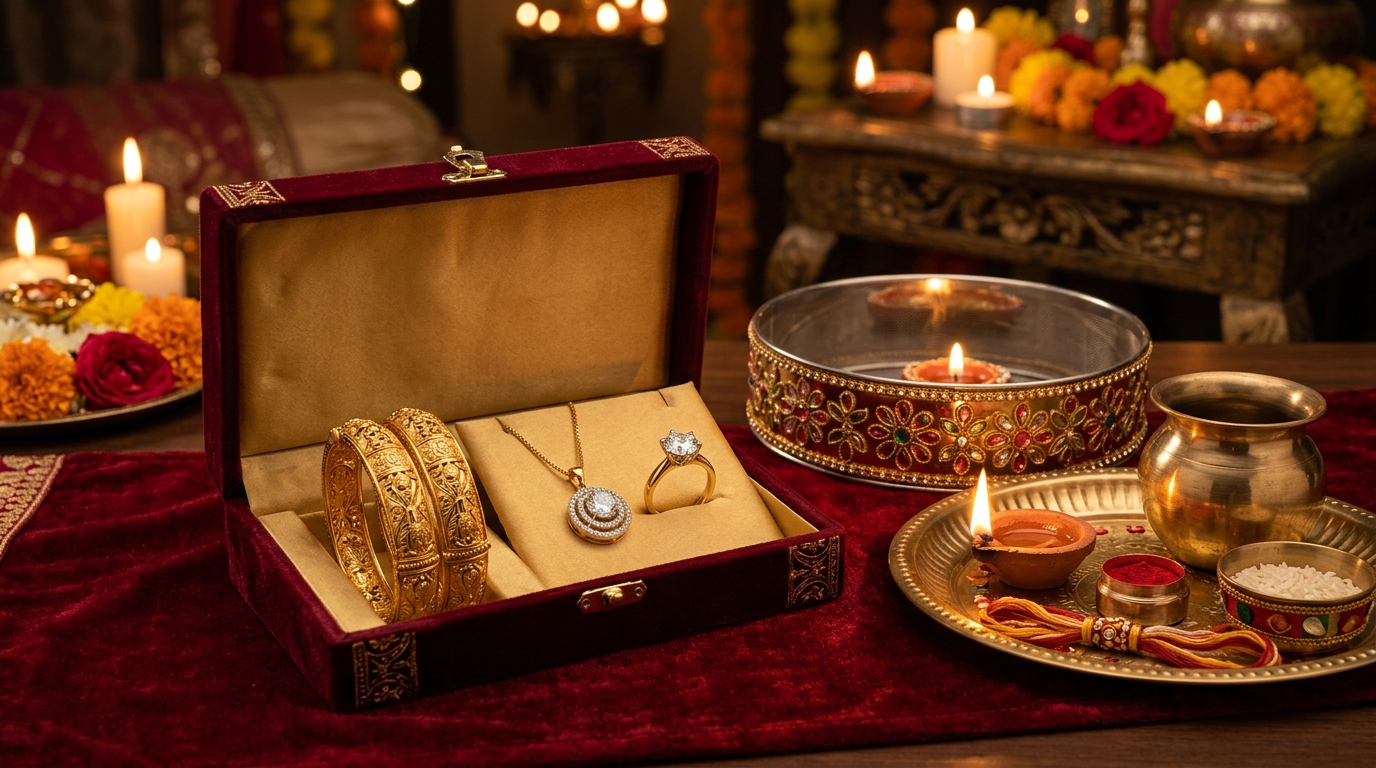
Karwa Chauth jewellery centers on solah shringar, the sixteen traditional adornments believed to bring marital prosperity. The must-haves are the chooda (red and white bangles), a mangalsutra, bindi, sindoor, and layered neckpieces. Pair statement jewellery with your outfit's neckline, not the other way around, and you'll nail the look without overthinking it.
Karwa Chauth isn't just about the fast or the moonrise. It's also the one day a year when jewellery takes center stage, carrying centuries of meaning packed into bangles, bindis, and neckpieces. If you're staring at your jewellery box wondering what actually matters versus what's optional, you're not alone. Let's break it down.

What is solah shringar and why does it matter on Karwa Chauth?
Solah shringar literally translates to "sixteen adornments." It's a traditional beauty ritual rooted in Hindu customs, where a married woman adorns herself head to toe as a symbol of devotion and good fortune for her husband. On Karwa Chauth specifically, this ritual isn't just decorative. Each element is tied to a belief about protection, prosperity, or marital bond.
You don't need all sixteen to feel complete. Most women today pick the ones that matter most to them and skip the rest. Think of solah shringar as a checklist you can customize, not a strict rulebook.
What are the sixteen elements of solah shringar?
Here's the traditional list, though interpretations vary by region and family:
Bindi, sindoor, maang tikka, kajal, nose ring (nath), earrings, necklace, mangalsutra, bangles (chooda), armlets (bajuband), rings, waist belt (kamarbandh), anklets (payal), toe rings (bichhiya), mehendi, and a fragrant hairstyle with flowers.
That's a lot. Realistically, most women focus on five or six of these on Karwa Chauth: the chooda, mangalsutra, bindi, sindoor, a statement necklace, and mehendi. The rest are nice-to-haves, not deal breakers.
What is a chooda and why is it central to Karwa Chauth?
The chooda is a set of red and white (sometimes also ivory or gold) bangles traditionally worn by newly married women. Red represents energy and new beginnings, while white symbolizes purity. On Karwa Chauth, the chooda holds extra weight because bangles themselves are considered auspicious for a married woman's wellbeing and her husband's long life.
If you're not newly married, you can still wear a chooda-style bangle set for the occasion. Plenty of women today opt for a smaller stack rather than the full bridal set, keeping it festive without feeling like a full bridal re-run.
How should you choose bangles beyond the chooda?
Bangles are arguably the most flexible piece of Karwa Chauth jewellery. You can stack a few gold kadas with your chooda, or go minimal with one statement cuff if your outfit already has a lot going on.
Here's a simple rule: if your kurta or saree has heavy embroidery on the sleeves, keep your bangles slim. If your sleeves are plain or three-quarter length, this is where you can go bold with stacked bangles in contrasting colors.
Explore Aza Fashions' jewellery collection if you want pieces that pair easily with chooda-style sets.
What other jewellery should you wear on Karwa Chauth?
Beyond bangles, here's what rounds out the look:
Mangalsutra: Non-negotiable for most married women, worn as both ritual and everyday symbol.
Statement necklace or choker: Pick one based on your neckline. A high neckline suits a choker, while a plunging or V-neck works better with a layered or longer necklace.
Jhumkas or chandbalis: These add festive drama without overwhelming the rest of your look, especially if your neck is already carrying a statement piece.
Maang tikka: Optional, but it photographs beautifully for the evening puja and moonrise moment.
If you want everything curated together instead of piecing it apart, check out the Karva Chauth Edit, which pulls outfits and jewellery pairings specifically for the occasion.
How do you balance jewellery with your outfit so it doesn't look overdone?
The easiest fix: pick one hero piece and let everything else support it. If your necklace is the star, keep earrings small. If you're going big on jhumkas, keep the neckpiece simple or skip it entirely.
Also, consider your outfit's fabric. Heavily embellished lehengas and sarees already carry visual weight, so chunkier jewellery can compete rather than complement. Simpler kurta sets or pre-draped sarees, on the other hand, give jewellery room to shine.
Pick what feels right for you
Solah shringar isn't a test you need to pass perfectly. It's a tradition you get to interpret. Whether you wear all sixteen elements or just your chooda and mangalsutra, what matters is that it feels meaningful to you.
If you're still figuring out your outfit, our first post in this series covers lehenga and suit ideas beyond the saree to help you plan the whole look together.
FAQs
Do I need to wear all sixteen solah shringar items on Karwa Chauth?
No. Most women wear five to six key pieces, like the chooda, mangalsutra, bindi, and a statement necklace. The full sixteen is traditional but not mandatory.
Can unmarried or newly engaged women wear a chooda on Karwa Chauth?
Yes, though the chooda is traditionally associated with newly married women. Many women now wear simplified bangle stacks in red and white regardless of marital status, purely for the festive spirit.
What's the difference between a kada and a chooda?
A kada is typically a single thick bangle, often worn by both men and women. A chooda is a full set of bangles, usually in red and white, worn specifically by married women during rituals and celebrations.
How many bangles should I wear if I'm not doing a full chooda set?
Four to six bangles per wrist is a comfortable middle ground, enough to feel festive without weighing down your hands through a full day of rituals.
Should my jewellery match my outfit color or contrast it?
Both work. Matching tones create a cohesive, elegant look, while contrasting jewellery (like gold against a jewel-toned outfit) makes the pieces pop more individually.

