


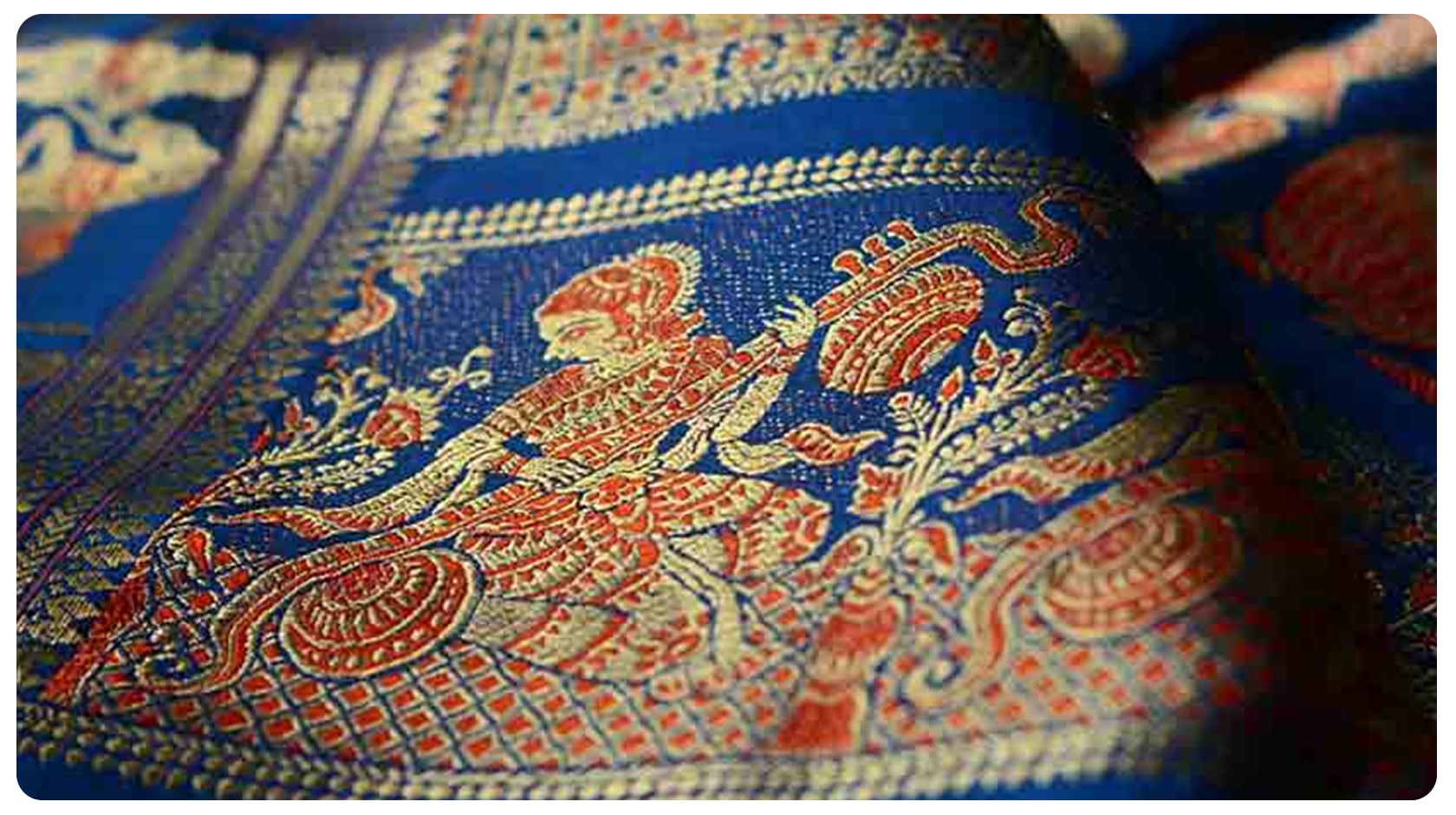

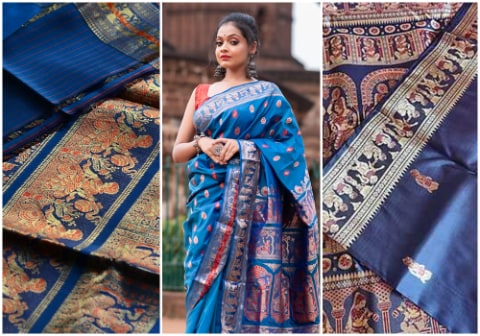
Imagine wearing a saree that doesn't just look beautiful but actually tells a story. On the silken canvas of the Baluchari Saree, ancient epics come alive. Warriors ride chariots, kings smoke hookahs, and scenes from the Ramayana and Mahabharata unfold in intricate weaves.
Hailing from West Bengal, the Baluchari saree is a masterpiece of Indian handloom heritage. It is not just a garment; it is a narrative woven in silk, celebrated for its spectacular pallu (the loose end of the saree) which acts as a storyteller.
In this post, we will journey through the history of this aristocratic saree, understand the complex art of weaving mythology into fabric, and explore the different types that make this craft so unique.
What is a Baluchari Saree?
A Baluchari saree is a traditional silk saree originating from Bengal. It is widely recognized for its polished, soft texture and, most importantly, its elaborate borders and pallu.
Unlike many other Indian sarees that feature floral or geometric patterns, the Baluchari is famous for depicting scenes. The pallu often acts like a picture book, showcasing elaborate motifs of human figures, animals, and royal court scenes. Historically worn by the aristocracy of Bengal, these sarees are considered a symbol of status and cultural pride.
A Tale of Two Cities: Murshidabad to Bishnupur
The history of the Baluchari saree is as dramatic as the scenes depicted on it. It spans centuries, moving from the banks of the Bhagirathi river to the terracotta temples of Bishnupur.
Origins in Baluchar
The saree gets its name from the village of Baluchar in the Murshidabad district of West Bengal. In the 18th century, the Nawab of Bengal, Murshid Quli Khan, was a great patron of the arts. He encouraged the weavers of Dhaka (now in Bangladesh) to settle in Baluchar. Under his patronage, the craft flourished, and the saree became a favorite among the noble women of the time.
The Great Migration
However, nature had other plans. A devastating flood in the Bhagirathi river submerged the village of Baluchar, forcing the weaver community to flee. They eventually found a new home in Bishnupur, in the Bankura district of West Bengal.
Bishnupur was already famous for its terracotta temples, which featured intricate carvings of mythological tales. These temple walls inspired the weavers, leading to the mythological motifs we see on Baluchari sarees today. Though the craft faced a decline during British rule due to financial and political pressure, it saw a significant revival in the 20th century thanks to artists like Subho Thakur, who helped reintroduce the art to the world.
The Art of Weaving Stories
Creating a Baluchari saree is a feat of engineering and artistry. It is not a simple print; every figure and motif is woven directly into the fabric using a loom.
The Process
The process begins with the cultivation of silkworms to produce high-quality silk yarn. Once the yarn is extracted, it is dyed in vibrant colors. Since Baluchari sarees are known for their rich look, the silk used is often of the finest quality.
The real magic happens during the design phase.
Drafting the Narrative: The motifs (pallavs) are first drawn on graph paper. Every pixel of the design corresponds to a thread on the loom.
Punch Cards: In the modern Jacquard weaving technique, these designs are punched onto cards. These cards act like computer code, telling the loom which threads to lift and which to lower to create the pattern.
Weaving: The cards are sewn together and attached to the Jacquard loom. The weaving process is grueling. A weaver works in shifts for five to six days (sometimes longer) to complete just one saree.
The result is a fabric where the design looks almost like embroidery but is actually part of the weave itself.
Design Elements: Myth and Royalty
The motifs on a Baluchari saree are its defining feature. They are categorized into two main themes depending on the era they draw inspiration from.
1. Mythological Scenes
Influenced by the temples of Bishnupur, many sarees feature scenes from Indian epics. You might find:
Lord Krishna speaking to Arjuna from the Bhagavad Gita.
Scenes from the Ramayana, such as Rama and Sita’s wedding.
Episodes from the Mahabharata.
2. Scenes from Royal Life
Traditional designs also document the social life of the 18th and 19th centuries. These "Nawabi" motifs capture the lifestyle of the aristocracy and even the Europeans of the East India Company. Common scenes include:
Women smoking hookahs.
Noble men riding horses or elephants.
Royal court sessions.
European officers in their distinct attire.
Types of Baluchari Sarees
While the technique remains similar, Baluchari sarees are categorized based on the threads and colors used.
1. Resham Baluchari
This is the simplest and most classic form. Here, the entire pattern is woven using Resham (silk) threads of a single color. The beauty lies in the texture and the subtle play of light on the single-tone silk.
2. Meenakari Baluchari
These sarees are more colorful. They use threads of two or more colors to create the patterns. The multi-colored threads make the motifs pop against the base color of the saree, giving it a vibrant and festive look.
3. Swarnachari Baluchari
The most opulent of them all is the Swarnachari. The name comes from "Swarna" (gold). In these sarees, the intricate patterns are woven using gold and silver threads (zari). This gives the saree a magnificent, illuminating effect. A Swarnachari saree is a popular choice for Bengali brides because of its grandeur and rich appearance.
Conclusion
The Baluchari saree is a testament to the resilience of Bengal's weavers. It survived floods, colonial suppression, and changing fashion trends to remain a beloved symbol of Indian heritage.
Wearing a Baluchari is like wearing a piece of history. Whether it is a scene from an epic battle or a quiet moment from a Nawab's court, the saree carries the weight of culture in its folds. For anyone looking to add a touch of intellect, spirituality, and royalty to their wardrobe, the Baluchari saree is the perfect choice.

