


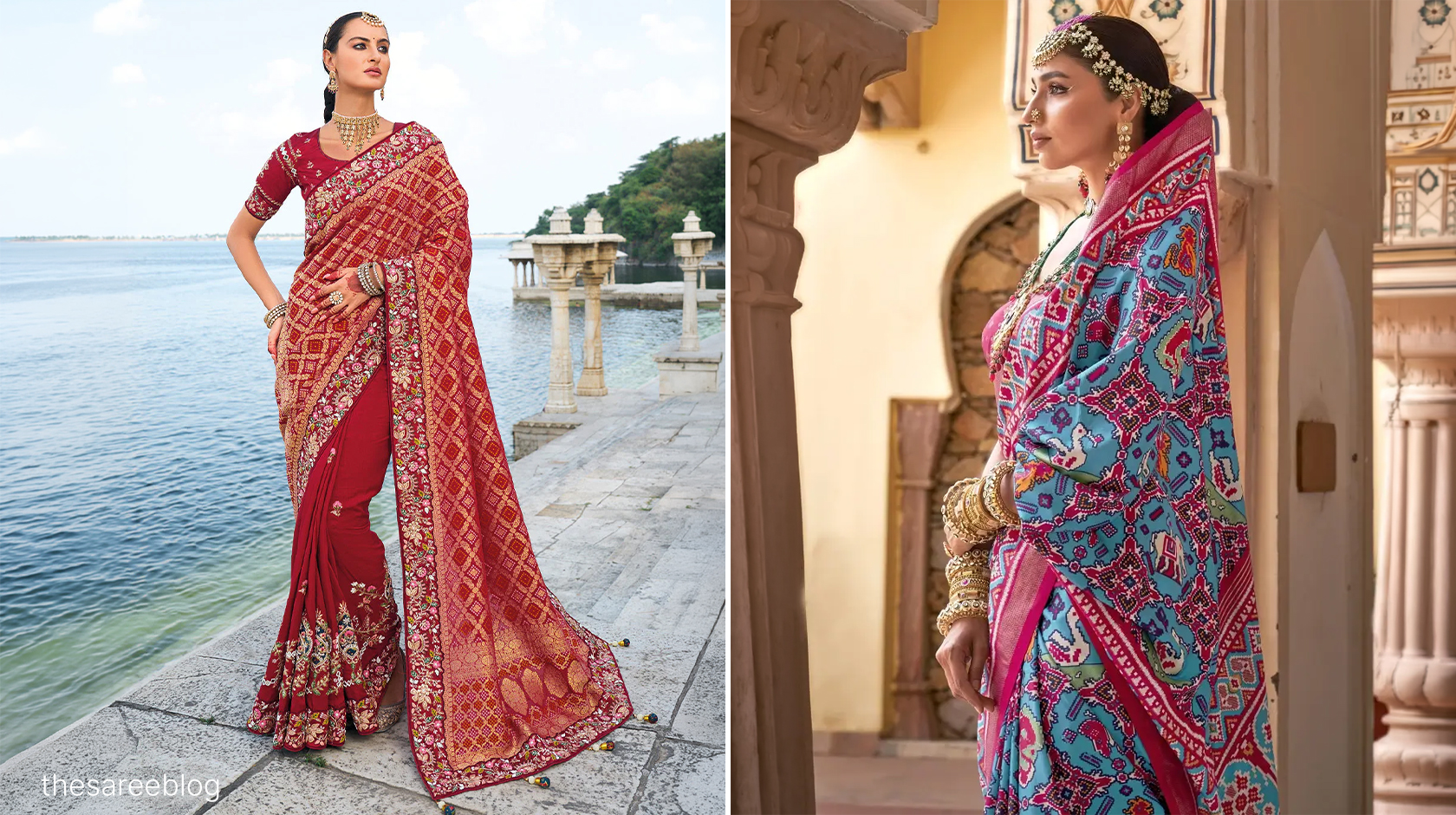
Gujarat is a land that has been weaving stories into fabric for over two thousand years. From the royal looms of Patan to the desert artisans of Kutch, from the tie-dye masters of Jamnagar to the embroidery communities of Saurashtra Gujarati textile tradition is one of the richest, most technically complex, and most visually magnificent in the entire world. The sarees that emerge from this tradition are not merely garments.

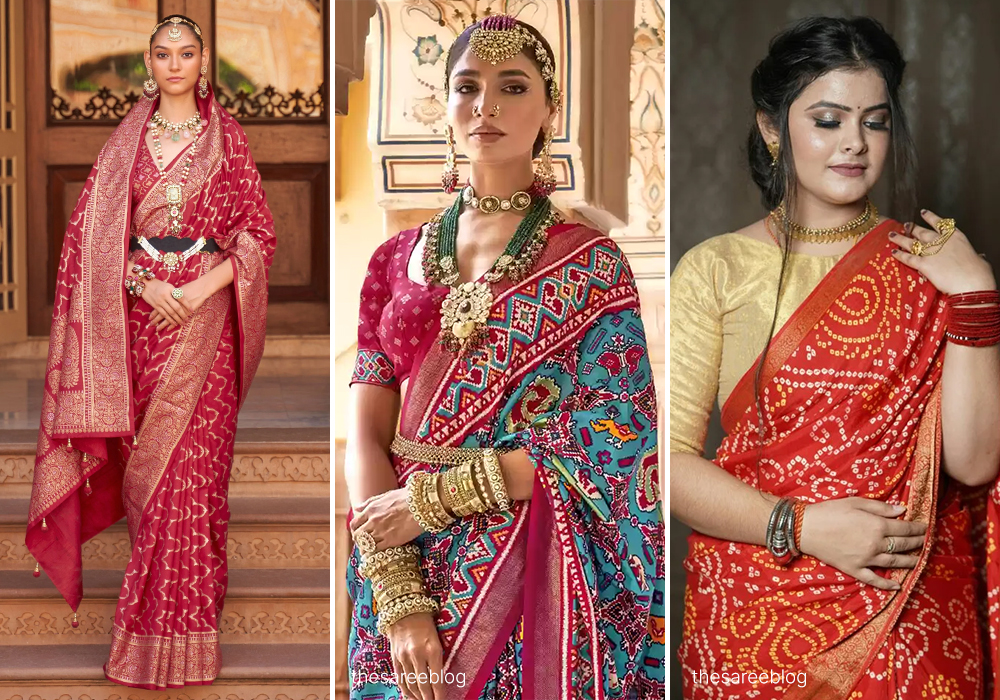
They are archives of culture, identity, geography, and generations of skill transferred hand to hand, loom to loom, across centuries. In 2026, as Gujarati sarees find their place on international runways and in the wardrobes of discerning women everywhere, this complete guide covers every significant traditional weave, its history, its distinctiveness, and how it is being interpreted for modern wear.
Why Gujarati Sarees Are Among India's Most Prized Textiles
Gujarat's textile supremacy is not accidental it is the product of several converging advantages:
Trade History For millennia, Gujarat's ports were the entry and exit points of India's most important trade routes. The demand from Arab, African, Southeast Asian, and European merchants for Gujarati textiles drove local weavers and craftspeople to develop techniques of extraordinary refinement. Textiles from Patan and Surat were traded as far as Egypt and Indonesia.
Community Specialization Gujarat's textile traditions are organized by community: specific castes and communities have specialized in specific techniques for generations. The Patola weavers of Patan, the Khatri block printers of Kutch, the Bandhani dyers of Jamnagar each community carries a technical lineage that cannot be replicated without that generational knowledge.
Royal Patronage Gujarati textiles were prized by royalty across India and the Mughal court. This patronage drove the development of the most labor-intensive and technically demanding techniques like the double ikat Patola that exist in Indian textile tradition.
Geographic Diversity Gujarat's varied landscape coastal, desert, forest, and plains produced equally varied textile traditions. The needs and aesthetics of a coastal fishing community in Saurashtra are utterly different from those of a desert nomad in Kutch, and both are different from the court weaver of Patan resulting in an extraordinary breadth of textile expression within a single state.
- Patola SareeTheQueen of Gujarati Weaves
What Is a Patola?
The Patola is widely regarded as the most technically complex handwoven saree in the world. Woven in Patan the ancient capital of Gujarat the Patola is a double ikat saree in which both the warp (vertical) and weft (horizontal) threads are resist-dyed before weaving, creating a pattern that is geometrically precise on both sides of the fabric. There is no right or wrong side to a Patola it looks identical from either face.
The Making Process
Creating a single Patola saree takes between six months to a year for a family of three weavers working together. The process involves:
- Thread preparation Pure silk threads are sorted, twisted, and aligned
- Resist tying Thousands of tiny threads are individually tied with cotton to resist dye according to the planned pattern
- Multiple dye baths The threads pass through several dye baths, with the ties removed and reapplied for each color
- Weaving The pre-dyed warp and weft are aligned on the loom with extraordinary precision so the patterns match perfectly at every intersection
A master Patola weaver advances the weave by millimeters at a time, checking alignment constantly. There is no margin for error a misalignment cannot be corrected after the fact.
Patola Patterns & Their Meaning
Traditional Patola patterns carry specific meaning and were historically worn only by specific communities:
- Nari Kunjar (Woman and Elephant) the most iconic Patola pattern; worn by royalty and wealthy merchants
- Paan Bhat (Betel Leaf) a geometric betel leaf pattern; among the most popular traditional designs
- Vohra Gaji a pattern associated with the Vohra Muslim community who historically commissioned specific Patola designs
- Chhabdi Bhat (Basket Pattern) a dense geometric pattern of great intricacy
- Phulwadi (Flower Garden) floral patterns in rich jewel tones
Why Patola Sarees Are So Expensive
Authentic double ikat Patola sarees from Patan cost between ₹50,000 and ₹5,00,000 or more, depending on the complexity of the pattern, the purity of the silk, and the fame of the weaving family. Today, only a handful of families in Patan most notably the Salvi family still practice the authentic double ikat technique. The scarcity of skilled weavers, the time required, and the irreproducibility of the technique make Patola sarees one of the most valuable textile investments in India.
Modern Interpretation
Contemporary designers have adapted Patola patterns onto georgette, crepe, and cotton bases at more accessible price points. While these are not authentic double ikat Patolas, they carry the visual language of the tradition into modern wardrobes elegantly.
- BandhaniSaree The Art of a Thousand Knots
What Is Bandhani?
Bandhani from the Sanskrit bandhan meaning "to tie" is Gujarat's most widely recognized textile tradition: a tie-dye technique in which fabric is pinched into tiny points and tied with thread before being dipped in dye. When the ties are removed, the fabric reveals a pattern of white or undyed circles against a dyed ground creating the distinctive spotted, dotted, or ringed patterns that are instantly recognizable as Gujarati.
The Making Process
Bandhani is practiced primarily in Jamnagar, Bhuj, Anjar, and Mandvi in Gujarat. The process involves:
- Fabric preparation Silk, cotton, or georgette fabric is washed and prepared
- Pattern marking A master craftsperson marks the pattern on the fabric with a wooden block dipped in fugitive dye
- Tying (Bandhna) Skilled craftswomen called Bandhaniyas use their fingernails to pinch tiny points of fabric and tie them with polyester or cotton thread. A skilled Bandhani artisan can tie up to 5,000 knots in a single day
- Dyeing The tied fabric is dipped in dye. Multiple colors require multiple dye baths with selective untying and retying between each bath
- Untying After the final dye bath, the threads are carefully removed, revealing the pattern
Types of Bandhani Patterns
- Shikari (Hunter) rows of small dots; the simplest and most common pattern
- Ekdali single-circle pattern; elegant and restrained
- Trikunti triangular arrangement of dots
- Chaubundi four-dot arrangement; associated with auspicious occasions
- Leheriya a wave pattern; technically a variant found more commonly in Rajasthan but practiced in Gujarat too
- Ambadal a mango motif Bandhani; especially popular in bridal sarees
Bandhani in Gujarati Weddings
Bandhani sarees hold a sacred place in Gujarati wedding culture. The bride traditionally wears a Bandhani saree particularly a red or maroon Gharchola Bandhani during post-wedding ceremonies. The Gharchola (literally "home cloth") is a red silk Bandhani saree with a distinctive gold grid pattern that is gifted to the bride by her in-laws making it one of the most emotionally significant garments in Gujarati bridal culture.
- Kutch Embroidery SareeTheDesert's Masterpiece
What Is Kutch Embroidery?
Kutch embroidery is not a single style but a family of embroidery traditions from the Kutch district of Gujarat each practiced by a specific community with its own stitches, motifs, and color palette. Kutch embroidery sarees are made on base fabrics (typically cotton, silk, or georgette) and then hand-embroidered using silk or gold thread with distinctive geometric and floral patterns.
Major Kutch Embroidery Styles
Ahir Embroidery characterized by bold geometric patterns, vibrant colors (red, green, yellow, blue), and the use of shisha (mirror) work. Mirrors embedded in the embroidery catch the light and create a dazzling visual effect. Ahir embroidery is the most recognized Kutch style internationally.
Rabari Embroidery associated with the nomadic Rabari pastoralist community. Features dense, intricate geometric patterns in black and red with white chain stitches. Rabari embroidery has a bold, architectural quality unique among Kutch traditions.
Mutwa Embroidery practiced by the Muslim Mutwa community of Kutch; features extremely fine, detailed work with tiny mirrors and silk thread in cool, sophisticated color palettes of blue, green, and white.
Suf Embroidery a geometric style worked from the reverse of the fabric, counting threads to create precise patterns. The result is a reversible embroidery of extraordinary technical discipline.
Jat Embroidery a bold, free-form embroidery style with large geometric shapes and strong color contrasts, reflecting the nomadic Jat community's aesthetic.
- TangaliyaSaree Gujarat's GI-Tagged Heritage Weave
What Is Tangaliya?
The Tangaliya is a handwoven saree from the Surendranagar district of Gujarat, practiced exclusively by the Dangasia weaver community for over 700 years. In 2009, Tangaliya weaving received a Geographical Indication (GI) tag from the Government of India formal recognition of its unique regional identity.
What Makes Tangaliya Distinctive
The defining characteristic of a Tangaliya saree is its extra warp technique additional threads are inserted into the weave to create raised, textured dots (called Daana, meaning grain or seed) on the fabric surface. These dots can number in the thousands across a single saree and create a distinctive tactile texture that is instantly identifiable to the touch.
Traditional Tangaliya sarees feature white dots on a dark (black, navy, or maroon) ground a stark, dramatic aesthetic that reflects the visual culture of the pastoral Surendranagar landscape. The dots symbolize seeds an agricultural metaphor for fertility and abundance.
- Surat Silk SareesTheCommercial Capital of Indian Textiles
What Is a Surat Saree?
Surat Gujarat's commercial powerhouse is the largest producer of synthetic and silk-blend sarees in India, responsible for a significant share of the country's total saree production. While Surat sarees are often machine-woven rather than handwoven, they represent the practical, accessible, and commercially vibrant face of Gujarati textile tradition.
Surat Crepe Sarees, Surat Georgette Sarees, Surat Art Silk Sarees, and Surat Banarasi (imitation) sarees are widely popular across India for their affordability, variety, and the quality of their print and embroidery work.
Surat's Contribution to Modern Saree Culture
Surat's mills and powerlooms have democratized the saree making beautifully printed and embroidered sarees accessible to women across all income levels. The city's role as India's textile hub means that Surat sarees are found in every state of India, making Gujarati textile influence effectively pan-Indian.
- MashruSaree The Fabric of Syncretic Beauty
What Is Mashru?
Mashru is a unique Gujarat textile with a fascinating history rooted in religious law. The word comes from the Arabic mashroo meaning "permitted." Mashru is a warp-faced fabric woven with a silk exterior and a cotton interior created for Muslim wearers for whom direct silk-to-skin contact was considered religiously impermissible, while the visible exterior of the garment could still be silk.
This theological compromise produced a fabric of extraordinary visual richness Mashru features bold vertical stripes in vivid, saturated colors (saffron, emerald, cobalt, magenta) woven into the silk warp, giving the exterior a jewel-like brilliance while the cotton weft keeps the interior breathable and permissible.
Mashru sarees and fabric are today appreciated purely for their aesthetic beauty worn by women of all communities for their vibrant color and unique texture.
- GharcholaThe Sacred Bridal Saree of Gujarat
What Is a Gharchola?
The Gharchola (literally "home cloth") is perhaps the most culturally significant saree in Gujarat it is the sacred bridal saree gifted to the bride by the groom's family during the wedding ceremony. A Gharchola is a red or maroon silk saree woven with a distinctive gold grid pattern (typically 12 or 108 squares on the body) and often combined with Bandhani tie-dye dots within each square.
The Gharchola is not merely a garment it is a ceremonial object. The bride wears it during post-wedding ceremonies and significant life events (the birth of a child, major festivals, religious occasions) throughout her married life. It is one of the most emotionally charged wedding gifts in any Indian wedding tradition.
How to Choose the Right Gujarati Saree: A Buying Guide
For Weddings & Bridal Occasions
- Bride: Gharchola (mandatory in Gujarati tradition), Patola (if budget allows), or a rich Bandhani silk
- Wedding guests: Bandhani silk, Kutch embroidery on georgette, or Surat silk in festive colors
- Mother of the bride/groom: Patola-print or Tangaliya in sophisticated dark tones
For Festivals
- Navratri: Bright Bandhani in red, green, yellow, or multi-color; Kutch embroidery with mirror work
- Diwali: Rich Surat silk or Mashru in gold and jewel tones
- Holi: Vibrant Bandhani in pink, purple, and orange
For Everyday & Office Wear
- Cotton Bandhani lightweight, breathable, and culturally resonant
- Tangaliya distinctive, understated, and professional
- Surat printed crepe or georgette easy to drape, widely available
How to Identify an Authentic Gujarati Saree
- Patola: Check for double-sided identical pattern; look for GI tag; buy only from certified Patan weavers or trusted heritage stores
- Bandhani: Authentic Bandhani has slightly uneven dots (because they are hand-tied); machine-printed imitations have perfectly uniform dots with no texture
- Kutch Embroidery: Real shisha work uses actual mirror pieces (slightly irregular); plastic mirror imitations are perfectly round and uniformly shiny
- Tangaliya: Look for the raised dot texture (Daana) that you can feel with your fingers; GI tag certification is available from certified sellers
- Gharchola: Authentic Gharchola is always silk with a woven (not printed) gold grid; printed imitations lack the texture of the woven squares
Gujarati Sarees in Modern Fashion (2026)
Gujarati textile traditions have never been more visible in contemporary Indian and global fashion:
- Designers like Manish Malhotra, Sabyasachi, and Abu Jani-Sandeep Khosla have incorporated Patola patterns, Bandhani, and Kutch embroidery into their couture collections
- Patola-print lehengas and gowns have become a staple of high-fashion bridal wear
- Bandhani fusion sarees combining traditional tie-dye with modern blouse cuts and draping styles are among the top-selling sarees on premium e-commerce platforms
- Kutch embroidery on contemporary silhouettes jackets, capes, and even Western garments has created a global market for Gujarati craft
- Sustainability movement has elevated authentic handloom Gujarati sarees as ethical fashion choices Patola, Tangaliya, and hand-block printed Kutch fabric are now positioned as luxury sustainable fashion
Regional Weaving Centers: Where to Buy Authentic Gujarati Sarees
|
Saree Type |
Primary Weaving Centre |
Best Place to Buy |
|
Patola |
Patan, North Gujarat |
Salvi family workshops, Patan; heritage saree stores in Ahmedabad |
|
Bandhani |
Jamnagar, Bhuj, Anjar |
Jamnagar market; Kutch craft fairs; Gujari Bazar, Ahmedabad |
|
Kutch Embroidery |
Bhuj, Kutch district |
Kala Raksha (NGO), Bhuj; Qasab cooperative |
|
Tangaliya |
Wadhwan, Surendranagar |
Direct from Dangasia weaver cooperatives |
|
Mashru |
Patan, Mandvi |
Patan craft stores; Ahmedabad's heritage textile shops |
|
Gharchola |
Jamnagar, Rajkot |
Established saree retailers across Gujarat |
|
Surat Silk |
Surat |
Ring Road saree markets, Surat; pan-India retailers |
Frequently Asked Questions (FAQ)
Q1. What is the most famous Gujarati saree? The Patola saree from Patan is the most famous and prestigious Gujarati saree a double ikat handwoven silk saree considered one of the most technically complex textiles in the world. It can take up to a year to weave and costs between ₹50,000 and ₹5,00,000 or more.
Q2. What is a Bandhani saree? A Bandhani saree is made using a tie-dye technique in which fabric is pinched into tiny points, tied with thread, and then dyed creating distinctive dotted, ringed, or geometric patterns. It is one of Gujarat's most widely practiced and recognized textile traditions, centered in Jamnagar and Kutch.
Q3. What is the Gharchola saree and why is it significant? The Gharchola is the sacred bridal saree of Gujarat a red or maroon silk saree with a woven gold grid pattern gifted to the bride by the groom's family during the wedding. It is worn throughout the bride's married life at important ceremonies and is one of the most emotionally significant garments in Gujarati wedding culture.
Q4. What is the difference between a Patola and a Bandhani saree? A Patola is a double ikat woven saree where the pattern is created by dyeing the threads before weaving resulting in a reversible, geometrically precise design. A Bandhani saree is made by tie-dyeing the finished fabric creating dotted or circular patterns on the surface. Both are silk-based Gujarati traditions but involve completely different techniques.
Q5. How can I identify an authentic Bandhani saree? Authentic hand-tied Bandhani has slightly uneven, raised dots with a tiny indentation at the center (where the thread was tied). Machine-printed imitations have perfectly uniform, flat dots without any texture. You can also unfold the fabric and check that the dots appear slightly puckered from behind.
Q6. Which Gujarati saree is best for a wedding? For a bride the Gharchola is the traditional must-have; Patola is the prestige choice. For wedding guests a Bandhani silk in festive colors, Kutch embroidery on silk or georgette, or a rich Surat silk are all excellent choices appropriate for the occasion.
Q7. What is a Tangaliya saree? Tangaliya is a GI-tagged handwoven saree from Surendranagar, Gujarat, made by the Dangasia community. It is distinguished by raised textured dots (Daana) created by an extra warp weaving technique traditionally featuring white dots on a dark ground, symbolizing seeds and agricultural abundance.

