Warli Art: A Complete Guide to India’s Ancient Tribal Painting
While these paintings look simple, they carry deep meaning. They are not just drawings; they are the voice of a tribe that has lived in harmony with nature for
Have you ever noticed beautiful, simple white figures dancing in circles on a red background? You might have seen them on a hotel wall, a coffee mug, or a designer saree. This is Warli art. It is one of India’s oldest and most loved forms of storytelling.
While these paintings look simple, they carry deep meaning. They are not just drawings; they are the voice of a tribe that has lived in harmony with nature for thousands of years.
In this guide, we will explore everything you need to know about Warli painting. We will look at where it came from, how it is made, and why it is still so popular today.
The Roots of Warli: A History Lesson
Warli art gets its name from the ‘Warli’ tribe. This is an indigenous tribe living in the mountainous and coastal areas of the Maharashtra-Gujarat border. You will find them mostly in the North Sahyadri range in India.
The roots of this art form go very deep. Historians believe that the tradition of Warli painting dates back to somewhere between 2500 and 3000 B.C. To put that in perspective, this style resembles the prehistoric cave paintings found at Rock Shelters of Bhimbetka.
For centuries, this art remained a secret of the tribe. It was not until the 1970s that the outside world truly discovered it. Before this, Warli art was not done for commercial reasons. It was a ritual. Women of the tribe, known as suvasinis, would paint the walls of their homes during weddings, festivals, and harvests. For the Warli people, art was a way to celebrate life and pray for prosperity.
Unique Design Elements of Warli Painting
What makes Warli art instantly recognizable? It is the distinct lack of straight lines.
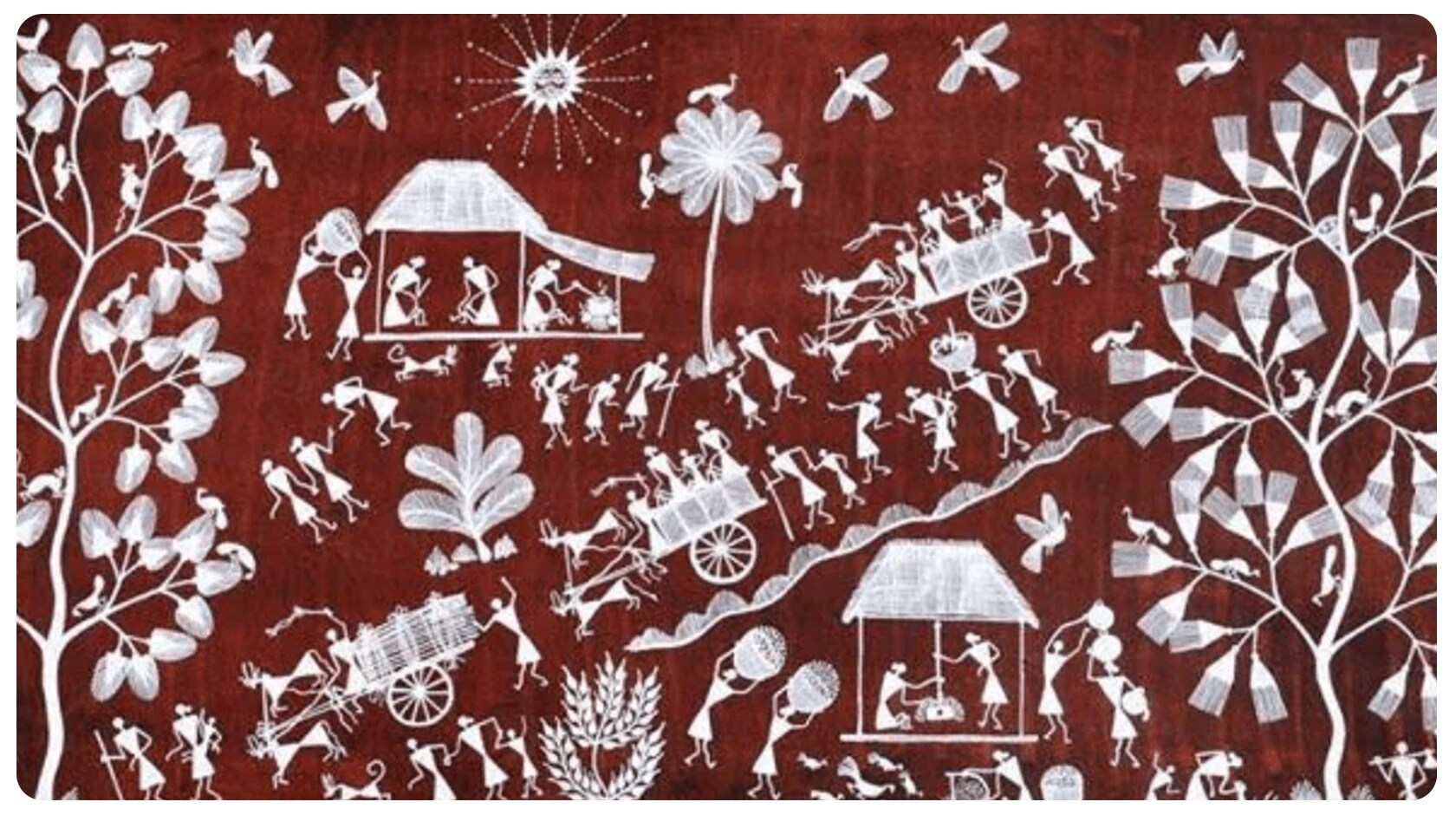
Unlike other Indian folk art forms that use bright colors and religious deities, Warli is different. It is monochromatic (usually white on red/brown) and focuses on social life. You will rarely find drawings of gods or mythological characters in traditional Warli art. Instead, you see regular people doing regular things.
Key Themes in Warli Art
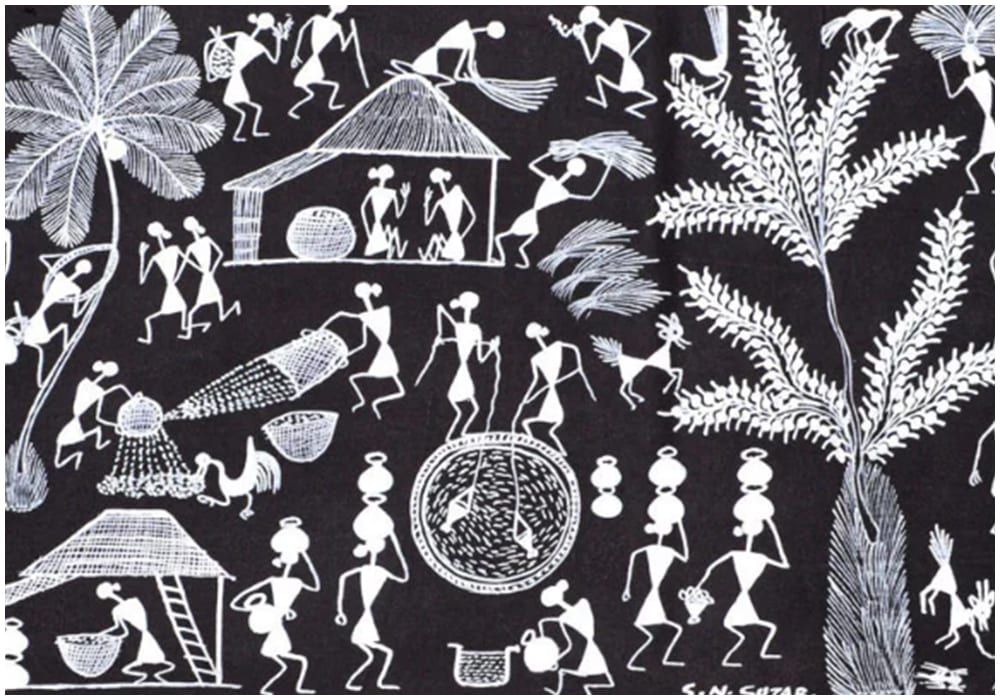
The paintings are like a window into the daily life of the tribal people. Common scenes include:
Farming and Harvesting: Men and women cutting crops or working in the fields.
Hunting and Fishing: Scenes of gathering food from the wild.
Festivals and Dance: The most famous motif is the circle of dancers.
Nature: Trees, animals, birds, and the sun are always present.
The philosophy behind these designs is simple: Human beings are a part of nature, not masters of it. This eco-friendly mindset is why Warli art feels so peaceful and grounded.
The Tarpa Dance: The Heart of Warli
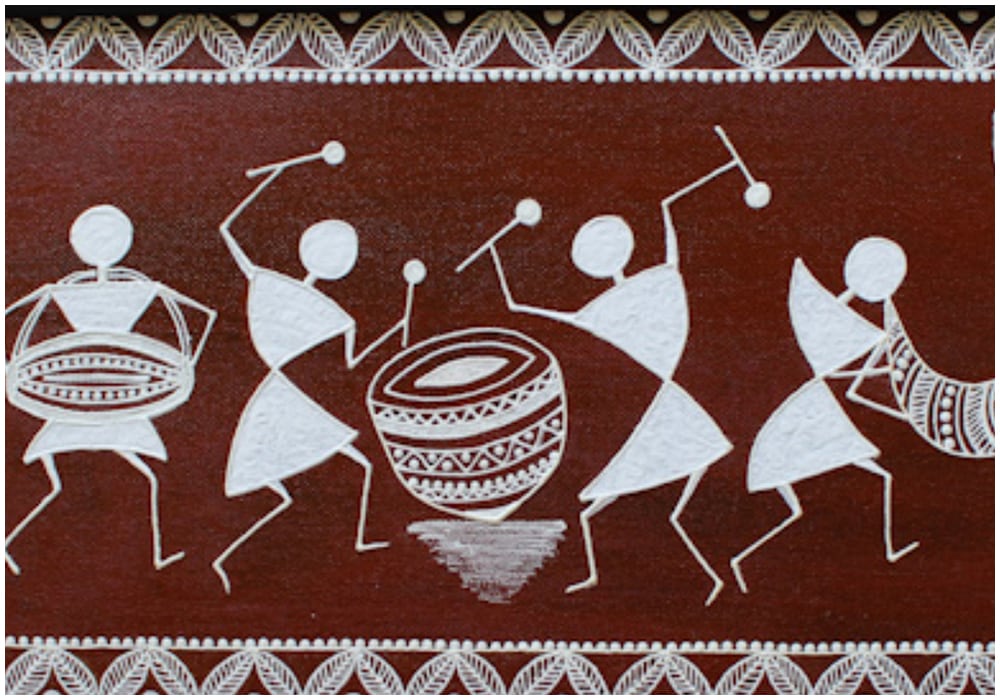
If you look closely at many Warli paintings, you will see a spiral or a circle of people holding hands. This represents the ‘Tarpa’ dance.
The Tarpa is a trumpet-like instrument made from dried gourd and bamboo. It is played by a musician who stands in the middle. Men and women join hands and dance in a circle around him. They move in sync, turning and winding without breaking the chain.
This circle is not just a dance formation; it is a symbol of the circle of life. It shows that life has no beginning and no end. The dancers follow the musician, just as humans follow the rhythm of nature.
Decoding the Symbolism: Shapes and Meanings
Warli art is famous for its geometric shapes. The artists use three main shapes to build their entire world: the circle, the triangle, and the square.
These shapes are not chosen at random. They come from the observation of nature.
1. The Circle
The circle represents the sun and the moon. Since the Warli tribe relies heavily on farming, the sun and moon are critical to their survival. The circle implies time, cycles, and the celestial bodies watching over them.
2. The Triangle
The triangle comes from looking at mountains and pointed trees. It is the primary building block for drawing humans and animals.
The Human Body: A human figure in Warli art is made of two triangles joined at the tip. The upper triangle represents the torso, and the lower triangle represents the pelvis. Their precarious balance symbolizes the balance of the universe.
3. The Square
The square is the one shape that does not come from nature. It represents human invention. It symbolizes a sacred enclosure or a piece of land. In ritual paintings, the square is often the central motif, known as the Chauk. Inside the Chauk, they often paint the Mother Goddess, Palaghata, symbolizing fertility.
Techniques: How Is Warli Art Made?
The beauty of Warli painting lies in its rustic, earthy materials. The traditional method is completely organic and eco-friendly.
The Canvas
In the villages, the canvas is the mud wall of a hut. The walls are made of a mixture of branches, earth, and red brick. To prepare the wall for painting, the women coat it with cow dung and then with red ochre (geru) mud. This gives the painting its signature reddish-brown background.
The Paint
The white paint creates a striking contrast against the dark wall. This paint is made from a mixture of rice paste, water, and gum (to make it stick). The white color represents purity.
The Brush
They do not use synthetic brushes. The artists use a bamboo stick chewed at the end to make it like a paintbrush. This allows them to create fine, textured lines.
While modern artists now use acrylic paints on canvas, paper, and cloth, the traditional artists still prefer these natural materials to keep the spirit of the art alive.
Warli in the Modern World
Warli art has traveled a long way from the mud walls of Maharashtra. Today, it is a global phenomenon.
Evolution of the Art
A major turning point for Warli art was the legendary artist Jivya Soma Mashe. He is often called the father of modern Warli painting. In the 1970s, he started painting on canvas and paper, not just walls. He moved away from purely ritualistic themes and started painting everyday stories. His work was exhibited in galleries across Europe and the USA, bringing international fame to this tribal art.
Fashion and Decor
Today, Warli is everywhere. You can find these geometric patterns on:
Textiles: Kurtas, sarees, dupattas, and scarves.
Home Decor: Cushion covers, bedsheets, vases, and wall hangings.
Accessories: Tote bags, jewelry, and even footwear.
Designers love Warli because it fits perfectly with modern minimalism. The clean lines and two-tone color scheme make it stylish yet traditional.
Why We Must Preserve Warli Art
In a world dominated by digital screens, Warli art reminds us of a simpler time. It teaches us about community, cooperation, and respecting the environment.
However, like many traditional arts, it faces challenges. Younger generations in the tribes are moving to cities for different jobs. There is a risk that the traditional methods might fade away.
By buying authentic Warli art, we support the tribal artists directly. It ensures that this knowledge is passed down to the next generation. When you buy a Warli painting, you don't just buy a picture; you buy a piece of history and culture.
Conclusion
Warli art is a beautiful example of how simple shapes can tell complex stories. From the rhythmic Tarpa dance to the humble rice-paste figures, every stroke has a meaning. It captures the spirit of rural India—unpretentious, connected to nature, and full of life.
Whether you are an art collector or just someone who loves beautiful things, adding a piece of Warli art to your life connects you to an ancient Indian legacy. Next time you see those white triangles on a red background, you will know exactly what story they are telling.
Aza Staff is a team of writers, creators, and industry insiders who live and breathe fashion. We explore the craft, culture, and creativity behind India’s luxury design scene, bringing you stories that are equal parts stylish and soulful.