



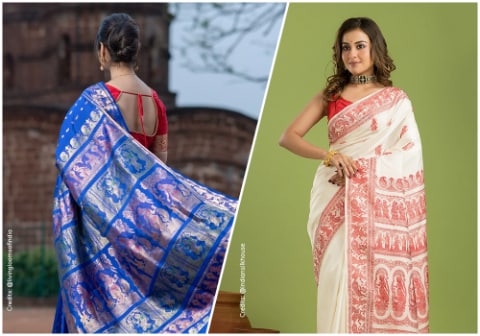
Imagine wearing a garment that doesn't just look beautiful but actually tells a story. In the rich textile heritage of West Bengal, there exists a saree that serves as a canvas for epics, folklore, and history. This is the Baluchari saree.
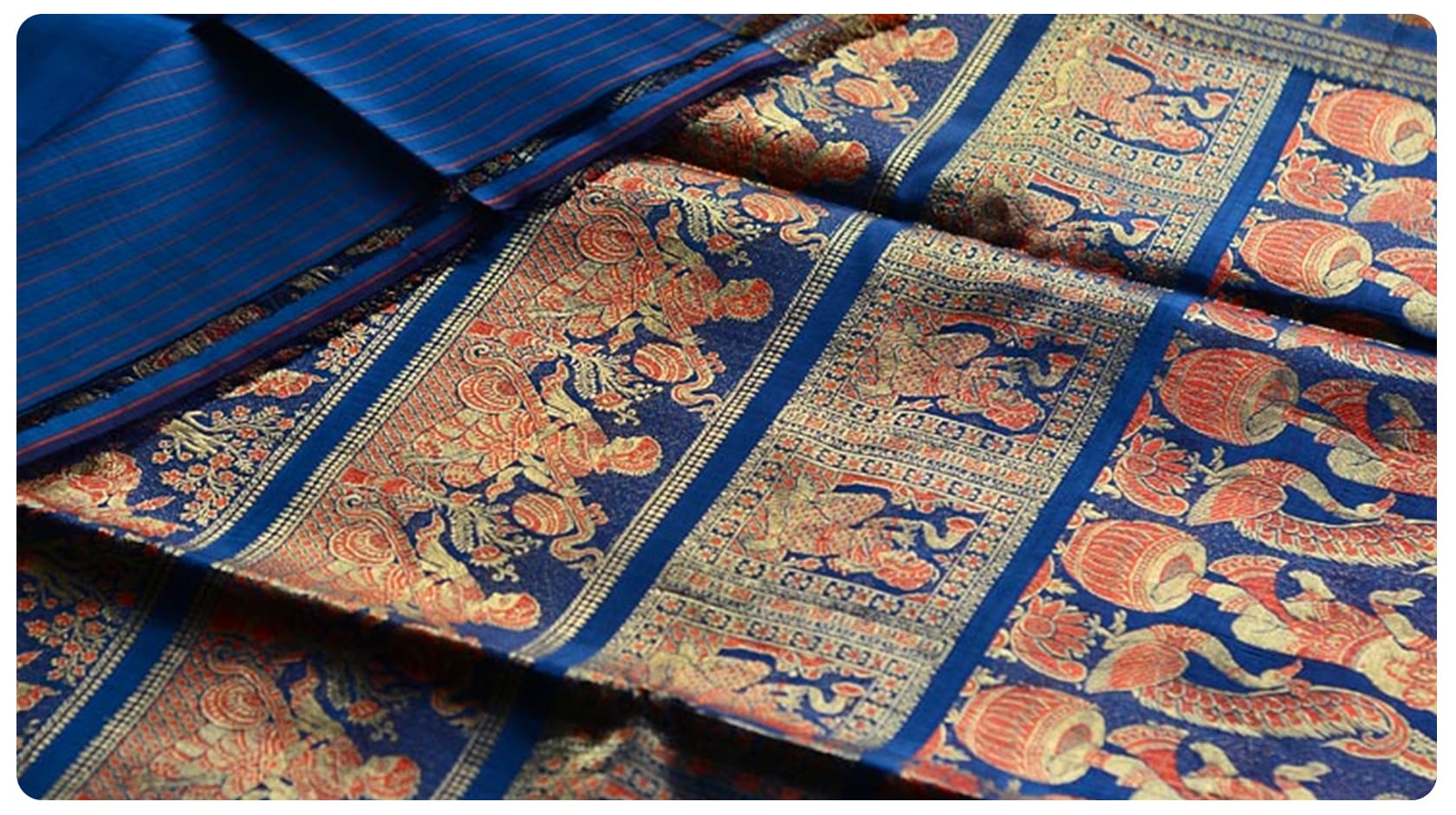
Famous for its intricate "pallu" (the decorative end piece) that depicts scenes from Indian mythology like the Ramayana and Mahabharata, the Baluchari is a masterpiece of handloom weaving. It is a symbol of aristocracy, art, and the rich cultural life of Bengal. Unlike other sarees that rely on floral or geometric patterns, the Baluchari focuses on human figures and narrative illustrations, making it truly one of a kind.
In this guide, we will explore the fascinating journey of the Baluchari saree, from the courts of the Nawabs to the wardrobes of modern fashion lovers.
What is a Baluchari Saree?
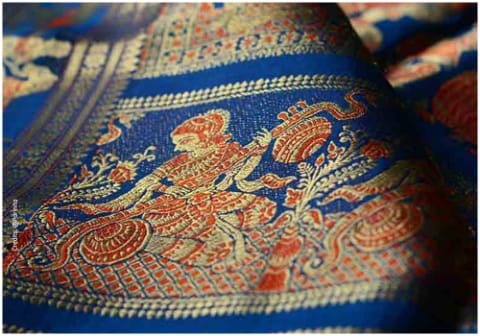
A Baluchari saree is a traditional silk saree that originates from West Bengal. It is historically linked to the city of Murshidabad but is currently produced mainly in Bishnupur.
The defining characteristic of a Baluchari saree is its pallu. The weavers use fine silk threads to weave complex narratives directly into the fabric. You might see a king holding court, a woman smoking a hookah, or a chariot riding into battle—all captured in silk. It is woven using a high-quality mulberry silk, giving it a polished and regal finish.
Tracing the Origins: A Tale of Two Cities
The history of the Baluchari saree is a journey of migration and survival. It dates back to 1704 CE, during the rule of Murshid Quli Khan, the first Nawab of Bengal. When the Nawab moved his capital from Dhaka to Maksudabad (which he renamed Murshidabad), he brought skilled artisans with him. These weavers settled in a village called Baluchar (now Jiaganj), giving the saree its name.
For over a century, the craft flourished under royal patronage. However, disaster struck when the Ganga river flooded, submerging the village of Baluchar. The weavers were forced to migrate again. They found a new home in Bishnupur, a town in the Bankura district famous for its terracotta temples.
Here, under the patronage of the Malla dynasty, the craft found a new life. The weavers began incorporating designs inspired by the terracotta carvings of Bishnupur’s temples, blending Mughal influences with Hindu mythology.
How It Is Made: The Art of the Jacquard Loom
Creating a Baluchari saree is an incredibly complex process that marries artistic vision with mechanical precision. It can take a weaver anywhere from one to two weeks to complete just one saree.
1. Silk Preparation
The process begins with sericulture—the cultivation of silkworms. The finest mulberry silk is extracted from cocoons and processed to make it soft and shiny.
- Cleaning: The raw silk is boiled in a mixture of soap and soda to remove natural gums.
- Dyeing: The yarn is then dyed in rich, acidic colors. Common colors include deep reds, purples, blues, and bright yellows.
- Stretching: The yarn is stretched by hand to make it crisp and strong.
2. The Design Process
This is where the magic happens.
- Graphing: The intricate designs are first drawn on graph paper.
- Card Punching: These designs are translated into a series of punch cards. These cards act like a computer code for the loom, telling it which threads to lift and which to lower to create the pattern.
- Jacquard Weaving: The cards are fed into a Jacquard machine attached to the handloom. As the weaver operates the loom, the machine guides the threads to weave the complex narrative scenes automatically.
Types of Baluchari Sarees
While the weaving technique remains consistent, Baluchari sarees are categorized based on the threads used for the motifs.
- Resham Baluchari: This is the simplest and most traditional form. It uses colored silk threads (Resham) of a single color to weave the entire pattern. The beauty lies in the texture and the monochrome elegance.
- Meenakari Baluchari: This style is more colorful. It incorporates threads of two or more colors to weave the motifs. The term "Meenakari" refers to the enameling work done on jewelry, and this saree mimics that vibrant, multi-colored look.
- Swarnachari: This is the most luxurious variant. It uses gold or silver-colored threads (Zari) to weave the motifs. A Swarnachari saree shimmers under the light and is often worn by brides or for very special occasions.
Design Elements: Wearing a Story
The design of a Baluchari saree is its soul. While the body of the saree often features small motifs (buttis) like paisleys or flowers, the borders and pallu are where the elaborate storytelling takes place.
The Pallu Narratives
The pallu acts as a canvas for the weaver. The themes are broadly divided into:
- Mythological: Scenes from the great Indian epics, the Ramayana and the Mahabharata. You might see the marriage of Rama and Sita, or Krishna instructing Arjuna on his chariot.
- Social and Royal Life: These designs depict the lives of the Nawabs and the aristocracy from the 18th and 19th centuries. Common motifs include noblemen riding elephants, women engaged in conversation, royal courts, and scenes of leisure like smoking hookahs.
This unique focus on human figures and narrative scenes sets Baluchari apart from other Indian silk sarees like Kanjeevaram or Banarasi.
Baluchari Today: A Timeless Classic
There was a time during British rule when the art of Baluchari weaving almost vanished. However, thanks to revival efforts in the 20th century, it has regained its glory.
Today, the Baluchari saree is protected by a Geographical Indication (GI) tag, which certifies that authentic Baluchari can only be produced in West Bengal. This helps protect the livelihood of the weavers in Bishnupur.
Modern Relevance
In the modern fashion world, the Baluchari is seen as a statement of intellect and heritage.
- Status Symbol: It is often worn by women who want to showcase a deep appreciation for Indian history and art.
- Global Appeal: The intricate, tapestry-like appearance of the saree has attracted attention globally. It is not just a garment; it is viewed as a piece of wearable art.
- Contemporary Tweaks: While the traditional designs remain popular, weavers are now experimenting with new color palettes—moving beyond the traditional reds and purples to include pastels and brighter hues—to appeal to younger generations.
Conclusion
The Baluchari saree is a testament to the resilience of Indian craftsmanship. It survived floods, shifting capitals, and changing eras, only to emerge more beautiful than before.
When you drape a Baluchari, you are not just wearing silk. You are carrying the legacy of the Nawabs, the devotion of the Malla kings, and the skill of the Bishnupur weavers.

