In a country overflowing with extraordinary wedding traditions, Gujarati weddings occupy a very special place not for their grandeur alone, but for the sheer joy they bring to every person in the room. From the electric energy of the Garba night to the deeply moving Kanyadaan, from the playful Juta Churai to the sacred Saat Phere a Gujarati wedding is a masterclass in how a community can hold centuries of tradition in one hand and pure, infectious celebration in the other.
In 2026, as Gujarati weddings continue to set trends across India and the global diaspora, this complete guide covers every ritual, tradition, and cultural detail that makes a Gujarati Biye truly unforgettable.
What Makes Gujarati Weddings Unique?
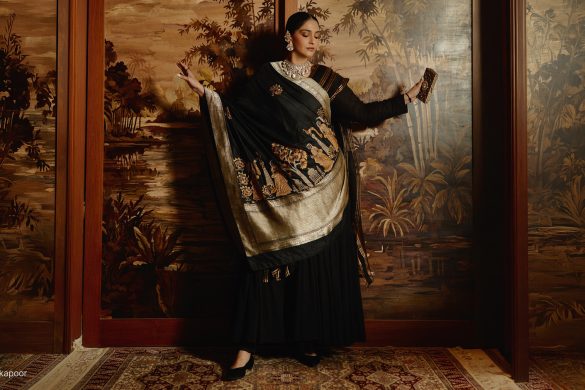
Gujarati weddings are shaped by a distinctive cultural philosophy: every ritual must be both sacred and joyful. Unlike wedding traditions in some other Indian states where solemnity dominates, Gujarati ceremonies are designed to make every participant from the youngest child to the oldest grandparent feel actively involved in the celebration. Dressing for these ceremonies? Lashkaraa's celebration wear at Aza covers every function on the calendar.
Three cultural forces define the Gujarati wedding experience:
The Vaishnava Tradition Gujarat is deeply influenced by Vaishnavism, particularly the Pushti Marg sect founded by Vallabhacharya. This tradition infuses Gujarati weddings with devotional songs, elaborate temple-style decoration, and a reverence for Lord Krishna that appears in rituals, music, and even bridal jewelry motifs.
The Merchant (Vanik) Community Spirit Gujarat's historic identity as a trading civilization gives its weddings a character of meticulous organization, generous hospitality, and community pride. A Gujarati wedding is never just a family event it is a community statement.
The Folk Tradition The Garba, Dandiya Raas, and Bhavai folk traditions of Gujarat bring an unparalleled energy to the wedding festivities. No other Indian state has a pre-wedding folk dance tradition as electrifying, as universally participated in, or as internationally recognized as the Gujarati Garba.
Pre-Wedding Rituals in Gujarat
Gol Dhana (Formal Engagement Ceremony)
The wedding journey begins with Gol Dhana Gujarat's distinctive engagement ceremony. The name comes from the two central elements: Gol (jaggery) and Dhana (coriander seeds) both offered to the gods and exchanged between families as symbols of sweetness and prosperity in the new alliance.
The groom's family visits the bride's home carrying gifts and sweets. The family priest chants mantras as jaggery and coriander seeds are offered at the family altar. The families then formally exchange these items along with gifts of clothing, dry fruits, and sweets. The Gol Dhana is followed by the distribution of mohanthal (a gram flour sweet) to all present a beloved Gujarati tradition marking every auspicious occasion.
Pithi Ceremony (Haldi)
The Pithi ceremony is Gujarat's equivalent of the Haldi ritual performed separately at both the bride's and groom's homes in the days before the wedding. A paste called Pithi is prepared from chickpea flour (besan), turmeric, sandalwood powder, and rose water. Female relatives apply this paste to the bride and groom while singing traditional Gujarati Lagna Geet (wedding folk songs).
In Gujarat, the Pithi ceremony carries an additional playful dimension younger relatives try to smear extra Pithi on the bride or groom's face, leading to much laughter. The yellow color of the paste is considered deeply auspicious, believed to bless the couple with health, radiance, and protection from the evil eye before the wedding.
Mameru (Maternal Uncle's Gift Ceremony)
Mameru one of Gujarat's most distinctive and emotionally significant pre-wedding traditions is the ceremony in which the bride's Mama (maternal uncle) presents an elaborate set of gifts to the bride ahead of the wedding. The Mameru gifts traditionally include a full bridal trousseau: sarees, jewelry, cosmetic items, sweets, and household items.
In traditional Gujarati families, the Mameru is a grand ceremonial arrival the Mama comes with his entire family in a procession, the gifts are arranged and displayed, and the bride's family welcomes them with music, sweets, and great warmth. The Mama's role in the wedding is one of the highest honors in Gujarati culture, and no wedding is considered complete without his presence and blessing.
Mehendi Ceremony
The Mehendi ceremony in Gujarati weddings is a full evening event festive, music-filled, and attended by women from both families. The bride's hands and feet are adorned with intricate henna designs featuring traditional Gujarati motifs: peacocks, parrots, elephants, and the iconic Sathiya (swastika) an auspicious Gujarati symbol. The groom's name hidden in the mehendi design is a beloved tradition, and the depth of color achieved is considered a measure of the strength of the couple's love.
In many Gujarati communities, the Garba folk dance is performed on the Mehendi night as a warm-up to the main Garba celebration making it one of the liveliest pre-wedding evenings across all Indian wedding traditions.
Garba Night (Sangeet)
The Garba night is not merely a pre-wedding event it is the cultural heartbeat of the entire Gujarati wedding. Held one to two nights before the wedding, it is an evening of Garba and Dandiya Raas the traditional circular folk dances of Gujarat performed in honor of Goddess Amba (Durga) and to celebrate the approaching wedding.
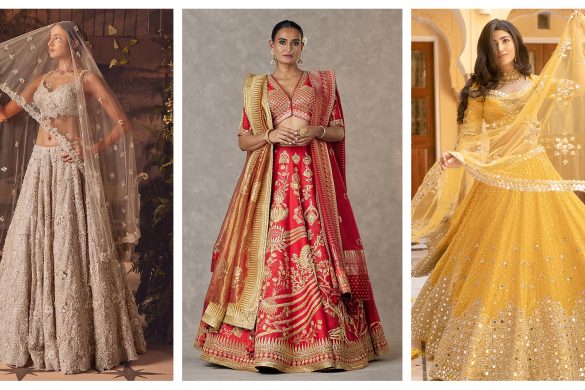
Women dressed in chaniya cholis (embroidered skirts and blouses) in brilliant colors twirl in concentric circles around a central lit lamp or image of the Goddess. Men join with dandiyas (decorated wooden sticks) for the rhythmic Dandiya Raas. Professional folk musicians or DJs play traditional Garba songs alongside modern Bollywood tracks, and the celebration continues late into the night.
In 2026, the Gujarati Garba night has become one of the most celebrated pre-wedding events across India attended not just by Gujarati families but by guests of all backgrounds who come specifically for this extraordinary evening.
Mandvo (Wedding Canopy Erection Ceremony)
Mandvo is the ritual construction and consecration of the wedding canopy the sacred space under which the main ceremony will take place. Unlike in other states where the mandap is simply a decorative structure, in Gujarat the Mandvo is a full ceremonial event with its own rituals.
The four poles of the Mandvo are erected by the bride's family's male relatives, and a priest performs a puja to consecrate the space. Mango leaves, banana stems, and marigold garlands are woven into the structure as symbols of auspiciousness and fertility. The ceremony is accompanied by Shehnai music and marks the formal beginning of the wedding at the bride's home.
Nandi Puja (Ancestral Invocation)
Before the main wedding rituals begin, Gujarati families perform Nandi Puja an invocation of the family's ancestors, seeking their blessings and asking them to witness the wedding. The family priest leads the ritual with Vedic mantras, and offerings of sesame seeds, flowers, and water are made. This ritual ensures that the blessings of the family lineage are present at the ceremony connecting the living couple to the generations that came before them.
The Main Wedding Day: Core Gujarati Rituals
Jaan (Groom's Procession)
The wedding day begins with the Jaan the groom's procession to the wedding venue. The groom, dressed in traditional Gujarati attire, arrives on a decorated horse (or in a modern car adorned with flowers) accompanied by his family and a dhol-shehnai procession. Female relatives of the bride's family come out to welcome the Jaan and perform a brief teasing ritual blocking the procession, demanding toll money (Dwar Dakhina), and engaging in good-natured banter before allowing the groom to enter.
Ponkhana (Welcome of the Groom)
At the entrance of the wedding venue, the bride's mother performs the Ponkhana a formal welcome ritual in which she receives the groom by performing an aarti, offers him a garland, and applies a tilak on his forehead. She then places a sacred thread (nada chhadi) around his wrist as a protective blessing. The Ponkhana is accompanied by the blowing of conch shells and the singing of auspicious songs by female relatives.
Jai Mala (Exchange of Garlands)
The bride and groom exchange flower garlands in the Jai Mala ceremony their first formal meeting under the Mandvo. In true Gujarati spirit, this moment is accompanied by much playful interference from both families brothers and cousins of the bride lift the groom high to prevent the bride from garlanding him, and vice versa creating one of the most photographed and laughed-about moments of the wedding.
Madhuparka (Reception of the Groom)
Madhuparka is a uniquely Gujarati ritual in which the bride's father formally receives the groom as an honored guest by offering him a mixture of honey, curd, and ghee (madhuparka) in a small vessel. The groom accepts this offering, touches it to his lips, and offers thanks. This ancient ritual one of the oldest described in Vedic texts recognizes the groom as a respected, auspicious guest worthy of the highest hospitality before he becomes the family's son-in-law.
Kanyadaan (Giving Away the Bride)
Kanyadaan in Gujarati weddings is performed with particular solemnity and emotional weight. The bride's father places his daughter's right hand in the groom's hand, pours sacred water (mixed with Gangajal, sesame seeds, and flowers) over their joined hands, and formally gives her away with Vedic mantras. The priest chants the specific Sanskrit verses of the Kanyadaan ritual, and the assembled family witnesses this sacred transfer.
In Gujarati tradition, the bride's Mama (maternal uncle) stands beside the bride's father during Kanyadaan his hand also placed on the bride's hand reflecting the maternal family's co-guardianship of the bride and the importance of the Mama's role throughout Gujarati wedding culture.
Haath Piria (Tying of Hands)
Haath Piria literally "hands tied together" is a distinctively Gujarati ritual in which the bride and groom's hands are tied together with a sacred thread by the priest. This binding symbolizes the indissoluble nature of the wedding vow the couple is now literally and spiritually connected. The tied hands are held together as the couple proceeds to the sacred fire for the Saat Phere.
Saat Phere (Seven Sacred Rounds)
The Saat Phere seven rounds taken together around the sacred fire are the spiritual and legal heart of the Gujarati Hindu wedding. With each round, a specific vow is made: for food and nourishment, for strength, for prosperity, for happiness, for progeny, for health, and for eternal friendship and companionship. The priest chants the corresponding mantras for each round, and the couple moves together the bride leading for some rounds and the groom for others in a choreography that reflects their equal partnership in marriage.
Sindoor Daan (Vermillion Application)
After the seven rounds, the groom applies sindoor (vermillion) in the bride's hair parting the singular act that completes the marriage ceremony. In Gujarat, the sindoor is applied three times once for the groom, once for the bride, and once for the divine witness making the Gujarati Sindoor Daan slightly distinct from the single application common in North Indian traditions.
Saptapadi Vows (Seven-Step Declaration)
Immediately following the Sindoor Daan, the couple takes seven steps together the Saptapadi each step accompanied by a spoken vow. In Gujarati tradition, these vows are recited aloud by both the bride and groom in their own language (Gujarati or Sanskrit), making the Saptapadi a remarkably participatory and personal declaration.
Post-Wedding Rituals in Gujarat
Vidaai (Bride's Farewell)
Vidaai the farewell of the bride is one of the most emotionally overwhelming moments of any Gujarati wedding. The bride tosses a fistful of rice and coins backward over her head as she departs symbolizing her gratitude to her parental home and her prayer for their continued prosperity. Traditional Vidaai Geet are sung by female relatives as she departs weeping, supported by her brothers and parents.
Gruhapravesh (Entry into the New Home)
The bride arrives at the groom's home and performs Gruhapravesh entering with her right foot first, tipping over a small vessel of rice at the threshold with her foot, symbolizing abundance flowing into the home with her arrival. The groom's mother performs an aarti and welcomes her as the new Grihalakshmi of the household.
Aeki Beki (Ring-Finding Game)
One of the most beloved post-wedding rituals in Gujarati tradition Aeki Beki is a playful game in which a ring (or coin) is dropped into a vessel of colored water, milk, or rose petals, and the bride and groom take turns trying to find it. The person who finds the ring more times is said to be the dominant partner in the marriage leading to much laughter, competition, and good-natured teasing. This playful game is designed to ease the tension of the first hours the couple spends together as a married pair.
Mooh Dikhai (Unveiling of the Bride)
The Mooh Dikhai ceremony the formal unveiling of the bride to the groom's extended family takes place on the first morning after the wedding. Each elder relative meets the bride for the first time, lifts her ghunghat (veil), offers a blessing, and presents a gift. This ceremony introduces the bride sequentially to every member of her new family and is both a social and ritualistic milestone.
Traditional Gujarati Wedding Attire
Bride
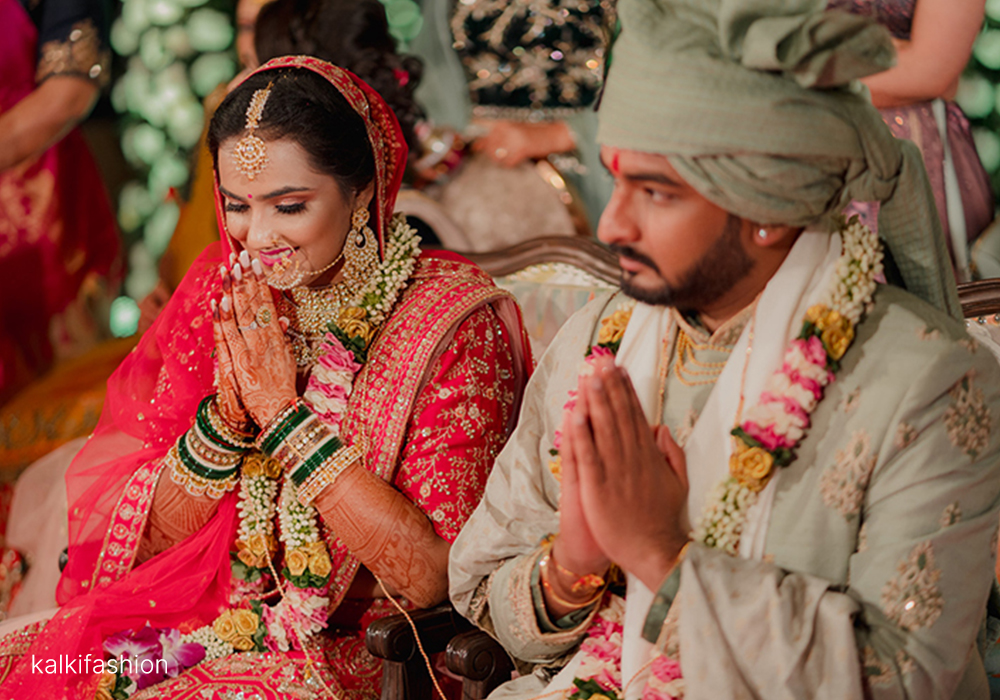
The Gujarati bride is resplendent in a Panetar saree a white saree with a red border, traditionally worn only by Gujarati brides on their wedding day. White represents purity and new beginnings; red represents prosperity and marital life. After the wedding, the bride changes into a Gharchola saree a red or maroon silk saree with a distinctive gold grid pattern gifted to her by the groom's family.
Traditional Gujarati bridal jewelry includes:
- Tikka (Maang Tikka) forehead ornament
- Nath nose ring
- Hath Phool a hand ornament connecting rings to a bracelet
- Kankana ceremonial gold bangles
- Payal silver anklets
- Mangalsutra the sacred wedding necklace
Groom
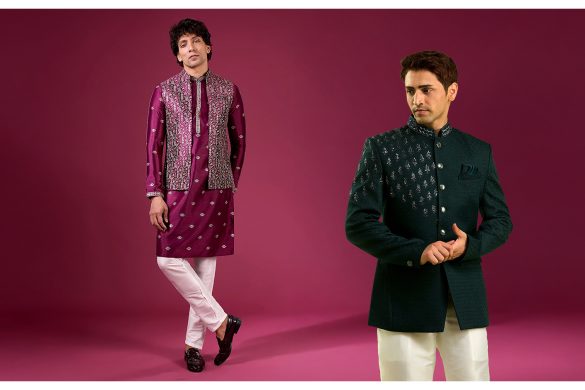
The Gujarati groom wears a white or cream dhoti-kurta or sherwani, paired with a safa (turban) in saffron or gold often adorned with a sehra (floral veil). A distinctive feature of Gujarati groom attire is the nada chhadi a sacred thread worn on the wrist from the Ponkhana ritual through the entire wedding ceremony.
Gujarati Wedding Food: A Vegetarian Feast
Gujarat is one of India's most predominantly vegetarian states, and Gujarati wedding feasts reflect this beautifully a riot of flavors, textures, and colors achieved entirely without meat:
- Dal Dhokli wheat flour dumplings simmered in a spiced lentil gravy
- Undhiyu a slow-cooked mixed vegetable dish; the crown jewel of Gujarati cuisine
- Sev Tameta nu Shaak tomato curry with sev (crispy gram flour noodles)
- Kadhi a yogurt-based curry with pakoras
- Puri and Bhakri deep-fried flatbreads and millet flatbreads
- Shrikhand strained yogurt sweetened with sugar and saffron; the most beloved Gujarati dessert
- Mohanthal gram flour fudge; a wedding sweet essential
- Lapsi broken wheat cooked with ghee and jaggery; served as a sacred sweet at the ceremony
- Churma Ladoo sweet wheat balls with ghee
- Fafda and Jalebi the iconic Gujarati morning combination served at pre-wedding breakfasts
Regional & Community Wedding Variations in Gujarat
Community | Distinctive Wedding Custom |
Leuva Patel | Extended Pithi ceremony; strong community witness traditions |
Kadva Patel | Elaborate Mameru; distinctive folk songs during Vidaai |
Anavil Brahmin | Stricter Vedic rituals; Gotra exchange central to ceremony |
Jain Gujarati | Wedding conducted under Jain religious tenets; no fire worship |
Saurashtra | Distinctive Saurashtra folk music; unique jewelry styles |
Kutchi | Kutchi embroidery on bridal attire; distinctive Kutchi Garba style |
Adivasi (Bhil, Rathwa) | Nature worship; bride price; community elder officiants |
Frequently Asked Questions (FAQ)
Q1. What are the main rituals in a Gujarati wedding? A Gujarati wedding includes pre-wedding rituals (Gol Dhana, Pithi, Mameru, Mehendi, Garba, Mandvo), main wedding ceremonies (Jaan, Ponkhana, Jai Mala, Madhuparka, Kanyadaan, Haath Piria, Saat Phere, Sindoor Daan), and post-wedding rituals (Vidaai, Gruhapravesh, Aeki Beki, Mooh Dikhai).
Q2. What is the Gol Dhana ceremony in Gujarati weddings? Gol Dhana is the formal Gujarati engagement ceremony. The name combines Gol (jaggery) and Dhana (coriander seeds) the two sacred items offered to the gods and exchanged between families as symbols of sweetness and prosperity in the new marriage alliance.
Q3. What saree does a Gujarati bride wear on her wedding day? A Gujarati bride traditionally wears a Panetar saree a white saree with a red border on her wedding day. After the ceremony, she changes into a Gharchola saree a red or maroon silk saree with a distinctive gold grid pattern gifted by the groom's family.
Q4. What is the Mameru ceremony in Gujarati weddings? Mameru is a pre-wedding ceremony in which the bride's maternal uncle (Mama) presents an elaborate trousseau of gifts to the bride including sarees, jewelry, and household items. It is one of the most emotionally significant pre-wedding rituals in Gujarati culture, reflecting the deep ceremonial importance of the maternal family.
Q5. What is the Aeki Beki ritual in Gujarati weddings? Aeki Beki is a playful post-wedding game in which the bride and groom search for a ring dropped into a vessel of colored water. The person who finds it more times is said to be the dominant partner in the marriage it is designed to ease the couple into their new life together through laughter and play.
Q6. Is Gujarati wedding food vegetarian? Yes. Gujarati wedding feasts are predominantly or entirely vegetarian, reflecting Gujarat's strong vegetarian cultural tradition. Signature dishes include Undhiyu, Dal Dhokli, Shrikhand, Mohanthal, and Lapsi a diverse, flavorful spread that showcases the richness of Gujarati vegetarian cuisine.
Q7. What is Haath Piria in Gujarati weddings? Haath Piria is a distinctive Gujarati ritual in which the bride and groom's hands are tied together by the priest with a sacred thread symbolizing the indissoluble nature of their wedding vow and their literal union before the sacred fire.