India is a civilization woven in silk, cotton, and gold thread. For over five thousand years, the saree has been its most enduring and magnificent expression a single length of unstitched fabric that transforms into a garment of infinite beauty, adapted across regions, communities, climates, and centuries without ever losing its essential character. Today, India is home to hundreds of distinct saree traditions each rooted in a specific geography, community, and history yet only a handful have achieved the kind of national and global recognition that makes them truly iconic. This guide celebrates 15 of the most significant traditional Indian sarees, exploring their origins, their making process, their defining characteristics, and the timeless elegance that makes each one irreplaceable in India's textile heritage.
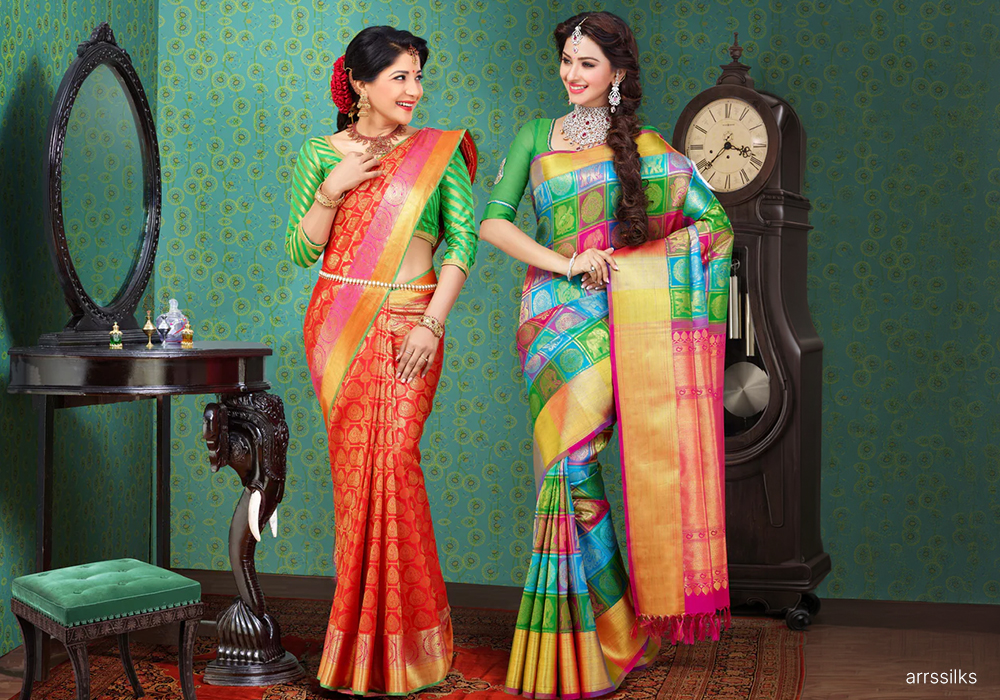
Why Indian Sarees Are Considered World Heritage Textiles
Before exploring individual sarees, it is worth understanding why Indian saree traditions occupy such an extraordinary place in world textile history:
Unbroken Continuity Many Indian saree traditions have been practiced continuously for over 1,000 years. The Patola saree of Patan appears in temple sculptures from the 10th century; the Kanjeevaram's roots stretch to the Pallava dynasty of the 7th century. No other living textile tradition in the world can claim this length of unbroken practice.
Technical Complexity Indian handloom sarees include some of the most technically demanding textiles ever created double ikat weaving, jamdani needle-weaving through the warp, and real zari threading with gold wire are techniques that machines cannot replicate and that take decades to master.
Community Identity Each saree tradition is inseparable from the community that makes it. The Kanjeevaram weaver is as much a cultural custodian as an artisan. To buy an authentic Indian handloom saree is to participate in the preservation of a living heritage.
Geographic Indication Dozens of Indian sarees have received Geographical Indication (GI) tags from the Government of India legal recognition that an authentic version of that saree can only be made in its region of origin, by its traditional community of weavers.
- Kanjeevaram(Kanjivaram) Saree Tamil Nadu
Origin & History
The Kanjeevaram saree woven in the temple town of Kanchipuram in Tamil Nadu is considered the queen of all Indian sarees. Its history stretches back to the Pallava dynasty (7th–9th century AD), when weavers from Andhra Pradesh were invited to settle in Kanchipuram and develop a weaving tradition worthy of the great temples being built there.
What Makes It Distinctive
- Woven from pure mulberry silk threads in both warp and weft
- Uses real zari silver wire coated with gold for the border and pallu designs
- The body, border, and pallu are woven separately and then interlocked a technique called korvai meaning the pattern never runs or separates even with age
- Motifs include temple gopurams, peacocks, elephants, checks (korvai checks), and traditional Tamil geometric patterns
- Minimum weight of a genuine Kanjeevaram is around 700–800 grams its weight is itself a mark of quality
Elegance Factor
The Kanjeevaram's combination of jewel-toned silk body and contrasting gold border creates a visual impact that is simultaneously regal and devotional earned through thousands of hours of skilled labor. It is the non-negotiable choice for South Indian brides and is widely considered the finest expression of Indian textile artistry.
- Banarasi SareeUttar Pradesh
Origin & History
The Banarasi saree from Varanasi (Banaras) has been woven for at least 600 years, with historical records suggesting its origins in the Mughal period when the city became a center of silk weaving under royal patronage. The Mughal aesthetic Persian floral patterns, gold brocade, and intricate jaal (net) designs defined the Banarasi style and remains visible in its patterns today.
What Makes It Distinctive
- Woven on draw looms (karkhana looms) with silk warp and silk or real zari weft
- Four main varieties: Pure Silk (Katan), Organza (Kora), Georgette, and Shattir (cotton-silk blend)
- Signature design elements include minakari (enameling), jangla (jungle/floral pattern), tanchoi (woven self-pattern), and butidar (all-over motif)
- The pallu (end piece) of a Banarasi saree is its most elaborately woven section often featuring multiple rows of different patterns
Elegance Factor
The Banarasi saree represents the highest meeting point of Mughal artistry and Indian weaving tradition a textile where Persian garden motifs bloom in Indian silk and gold. It is the definitive saree for North Indian weddings and is among the most internationally recognized of all Indian textiles.
- Patola SareeGujarat
Origin & History
The Patola from Patan in Gujarat is the rarest and most technically demanding saree in India. Woven by the Salvi community for over 900 years, the Patola was historically so prized that it was traded across Southeast Asia Indonesian batik artists studied Patola patterns, and Patola fragments have been found in Egyptian archaeological sites.
What Makes It Distinctive
- A double ikat weave both warp AND weft threads are resist-dyed before weaving, so the pattern is determined before a single thread goes on the loom
- The resulting fabric is identical on both sides there is no wrong side to a Patola
- Takes 6 months to 1 year for a family of three to complete a single saree
- Iconic patterns include Nari Kunjar (woman and elephant), Paan Bhat (betel leaf), and Vohra Gaji
Elegance Factor
A Patola saree is the closest a textile can come to being a living mathematical proof every thread intersection is precise, pre-planned, and unrepeatable. Its elegance is intellectual as much as visual: the more you understand how it is made, the more beautiful it becomes.
- ChanderiSaree Madhya Pradesh
Origin & History
The Chanderi saree is woven in the ancient town of Chanderi in Madhya Pradesh a weaving center since at least the 11th century. The town is mentioned in ancient texts and was a significant center of textile production during the medieval Malwa Sultanate period.
What Makes It Distinctive
- Woven from a distinctive combination of silk warp and cotton weft creating a fabric that is simultaneously sheer and structured
- Known for its gossamer lightness a Chanderi saree can be passed through a finger ring
- Characterized by coin motifs (asharfi buti), geometric patterns, and the iconic Chanderi buti (small woven motifs)
- Three varieties: pure silk Chanderi, silk-cotton Chanderi, and pure cotton Chanderi
- GI-tagged by the Government of India
Elegance Factor
Chanderi's elegance is that of understatement a translucent, feather-light fabric that drapes with extraordinary grace. It is the saree of women who understand that the subtlest things are often the most beautiful.
- Pochampally(Ikat) Saree Telangana
Origin & History
The Pochampally ikat saree from the Bhoodan Pochampally village in Telangana is India's most famous single ikat weave. The village which has been weaving for centuries was designated as Asia's best tourism village by the United Nations World Tourism Organization in 2021. Pochampally's ikat tradition is a UNESCO-recognized intangible cultural heritage.
What Makes It Distinctive
- Uses the single ikat technique either the warp or the weft threads are resist-dyed before weaving (unlike the double ikat Patola where both are dyed)
- Creates a distinctive blurred, feathered edge to the pattern that is the hallmark of ikat weaving a softness that no print can replicate
- Patterns include geometric diamonds, hexagons, and flowing abstract forms in bold color combinations
Elegance Factor
Pochampally ikat's elegance is in its deliberate imprecision the slight blur at pattern edges that results from the ikat process creates a dreamlike quality, as though the pattern is dissolving into the fabric itself.
- PaithaniSaree Maharashtra
Origin & History
The Paithani saree from Paithan in Aurangabad district, Maharashtra has a history stretching back 2,000 years it is mentioned in ancient Sanskrit texts and was a prized gift in the courts of the Satavahana dynasty. Today it is the most prestigious saree of the Maharashtrian Hindu community and is considered essential for Maharashtrian brides.
What Makes It Distinctive
- Woven on pit looms using pure silk with a real zari border and pallu
- The pallu features the iconic peacock motif (mor) woven using the tapestry weaving technique each color is woven separately rather than carried across the width
- The border features a distinctive oblique pattern unique to Paithani
- Colors are traditionally vivid and contrasting a green body with a maroon border, a purple body with a gold border
- A single Paithani can take 6 months to 2 years to complete
Elegance Factor
The Paithani peacock pallu is one of the most visually magnificent elements in all of Indian textile tradition a jewel-colored bird woven in silk and gold that seems almost to breathe. The Paithani does not merely drape a woman it crowns her.
- Sambalpuri SareeOdisha
Origin & History
The Sambalpuri saree from the Sambalpur district of Odisha is one of India's finest ikat weaving traditions practiced by the Meher weaver community for over 500 years. Sambalpuri sarees have received a GI tag and are among the most recognizable sarees of Eastern India.
What Makes It Distinctive
- Uses Bandha (ikat) technique resist-tying and dyeing of threads before weaving
- Woven in both silk and cotton versions
- Iconic motifs include the Shankha (conch shell), Chakra (wheel), Phula (flower), and Deer all drawn from Odisha's rich religious and natural iconography
- The Bomkai Sambalpuri a variant featuring supplementary weft weaving is particularly prized
Elegance Factor
Sambalpuri sarees carry the spiritual vocabulary of Odisha conch shells and temple wheels woven into everyday fabric. Their elegance is devotional: to wear a Sambalpuri is to wear the prayers and symbols of a civilization.
- Jamdani SareeWest Bengal
Origin & History
The Jamdani saree from Dhaka (historically) and Nadia, West Bengal is one of the oldest and finest muslin weaving traditions in the world. Mentioned in ancient texts as Woven Air, Dhaka muslin Jamdani was so fine that European traders reportedly mistook it for running water. The Jamdani tradition is now recognized as a UNESCO Intangible Cultural Heritage.
What Makes It Distinctive
- The design is created by inserting supplementary weft threads by hand using a needle directly through the warp called the jamdani technique without any loom mechanism
- Results in a sheer, light fabric with patterns that appear to float on the surface rather than being woven into it
- Traditionally woven in natural white or off-white cotton, though silk Jamdani is now widely produced
- Traditional motifs include butidar (all-over floral), jalar (net pattern), and panna hajar (thousand emeralds) the rarest and most complex Jamdani design
Elegance Factor
Jamdani's elegance is the elegance of pure light a fabric so sheer it is almost not there, with patterns that seem to hang in the air. To wear a fine Jamdani is to wear the most sophisticated understatement imaginable.
- Kasavu(Kerala) Saree Kerala
Origin & History
The Kasavu saree also called the Kerala saree or Mundum Neriyathum in its two-piece form is the traditional saree of Kerala Hindu women, woven in Balaramapuram, Chendamangalam, and Kuthampully in Kerala. Its origins are rooted in the temple weaving traditions of the state.
What Makes It Distinctive
- Woven from pure cotton with a distinctive gold (zari) border off-white or cream body with a pure gold border
- The contrast of white and gold is the defining aesthetic of Kerala textile tradition
- The two-piece version (Mundum Neriyathum) consists of a lower garment and an upper drape the traditional dress of Kerala women
- The single-piece Kasavu saree is worn as a traditional drape at weddings and festivals
- Set Kasavu a version with a broader gold border is the most formal variety worn at weddings
Elegance Factor
The Kasavu saree's elegance is spiritual simplicity the absolute purity of white and gold, without ornamentation or complexity. It is the most genuinely understated saree in India's tradition and among the most difficult to wear with the grace it deserves.
- Tant SareeWest Bengal
Origin & History
The Tant saree is the everyday silk-cotton saree of Bengal, woven in Shantipur and Fulia in West Bengal. While it lacks the international prestige of Jamdani or Banarasi, the Tant is arguably the most beloved saree in India worn daily by Bengali women across generations, classes, and occasions.
What Makes It Distinctive
- Woven from pure cotton on fly-shuttle pit looms
- Lightweight, breathable, and extremely comfortable designed for Bengal's hot and humid climate
- Features woven borders in contrasting colors and simple geometric or floral patterns
- Available at remarkably accessible price points making quality handloom accessible to all
Elegance Factor
The Tant's elegance is democratic it is the saree of the schoolteacher and the homemaker, the grandmother and the college student. Its beauty lies in its honesty: a well-draped Tant saree on a Bengali woman is one of the most naturally beautiful sights in Indian everyday life.
- MysoreSilk Saree Karnataka
Origin & History
The Mysore Silk saree was developed under the patronage of the Mysore royal family (Wodeyar dynasty) in the early 20th century when Maharaja Krishnaraja Wadiyar IV established the Karnataka Silk Industries Corporation to produce high-quality silk sarees for the state. The tradition has produced one of India's finest silk weaving traditions over the past century.
What Makes It Distinctive
- Woven from 2-ply pure mulberry silk slightly heavier and more lustrous than other silk sarees
- Known for its distinctive sheen Mysore silk has a smooth, almost mirror-like surface quality unique to its thread processing technique
- Features pure gold zari borders and simple, elegant patterns that allow the silk's natural beauty to be the focus
- The KSIC (Karnataka Silk Industries Corporation) certifies genuine Mysore silk with a silk mark
Elegance Factor
Mysore silk's elegance is aristocratic restraint a saree that announces quality through the quality of its silence. The fabric speaks for itself without needing elaborate patterns or heavy embellishment.
- Phulkari SareePunjab
Origin & History
Phulkari literally "flower work" is an embroidery tradition from Punjab with roots stretching back several centuries. Traditionally, Phulkari was not a saree but a dupatta or shawl embroidered by women for their own household use created as part of a bride's trousseau. Today, Phulkari sarees plain fabric embroidered with Phulkari motifs are among the most vibrant and joyful textiles in India.
What Makes It Distinctive
- Embroidered on the wrong side of the fabric the running stitch worked from the back creates the pattern on the front
- Uses pat silk thread in vivid colors (red, orange, yellow, blue, green) on plain cotton or cotton-silk ground fabric
- Two main varieties: Phulkari (floral motifs with ground fabric visible) and Bagh (the densest form where embroidery covers the entire surface, hiding the ground fabric)
- Motifs include wheat sheaves (ears of grain), flowers, birds, and geometric patterns drawn from Punjabi agricultural and folk life
Elegance Factor
Phulkari's elegance is joyful abundance a riot of color and pattern that reflects the generous, celebratory spirit of Punjabi culture. It is the saree equivalent of a Bhangra dance impossible not to feel happy in.
- UppadaJamdani Saree Andhra Pradesh
Origin & History
The Uppada Jamdani saree from the Uppada village in East Godavari district of Andhra Pradesh is one of India's finest and most distinctive weaving traditions combining the jamdani technique (needle weaving) with the local silk weaving tradition to create a fabric of extraordinary lightness and beauty. Uppada received its GI tag in 2009.
What Makes It Distinctive
- Uses the jamdani technique but on pure silk rather than cotton creating a silk fabric of gossamer sheerness
- The silk jamdani weave creates patterns that appear to be floating on air even lighter than the cotton Jamdani of Bengal
- Traditional motifs include mango (paisley), flowers, and geometric patterns in the Andhra tradition
- The saree is so light that it is often compared to tissue paper in weight
Elegance Factor
The Uppada Jamdani is the most ethereal saree in India a fabric that makes the wearer appear to float. Its elegance is otherworldly, as though the saree belongs to a category of beauty beyond ordinary experience.
- BandhaniSaree Gujarat & Rajasthan
Origin & History
Bandhani the ancient tie-dye tradition has been practiced in Gujarat and Rajasthan for at least 5,000 years. The earliest evidence of tie-dye in India comes from Mohenjo-daro archaeological sites. The tradition is centered in Jamnagar and Bhuj in Gujarat and Jodhpur and Jaipur in Rajasthan.
What Makes It Distinctive
- Created by pinching fabric into thousands of tiny points and tying them with thread before dyeing
- The untying of threads after dyeing reveals the pattern tiny circles and dots arranged into elaborate overall designs
- A complex Bandhani saree can have over 75,000 individual tie points all made by hand
- Key varieties include Gharchola (sacred bridal Bandhani of Gujarat), Leheriya (wave-dyed variant of Rajasthan), and Mothda (a dense, large-dot variety)
Elegance Factor
Bandhani's elegance is the elegance of infinite patience the realization that every dot on the fabric was individually tied by a human hand. It is beauty that rewards close examination.
- Muga Silk SareeAssam
Origin & History
The Muga silk saree is the most precious and exclusively Assamese textile in the world. Muga silk produced by the Antheraea assamensis silkworm is found only in Assam and nowhere else on Earth. It has been woven for at least 600 years and was historically a royal fabric reserved for Ahom kings.
What Makes It Distinctive
- Made from Muga silk a naturally golden silk that grows more lustrous and deepens in color with every wash rather than fading
- The natural golden color of Muga silk cannot be replicated by any dye it is inherent in the silk protein itself
- A Muga silk saree is expected to last 50–100 years and is considered an heirloom textile
- Woven with traditional Assamese motifs including Kingfisher (Moina Sorai), Elephant, and Assamese floral patterns
- Often combined with Pat silk (white Assamese silk) and Eri silk (peace silk, produced without killing the silkworm)
Elegance Factor
Muga silk's elegance is geological like gold ore, it is rare, natural, irreproducible, and grows more beautiful with time. A Muga silk saree is not just a garment it is a natural wonder, a piece of Assam's ecosystem woven into fabric.
Quick Comparison: 15 Traditional Indian Sarees at a Glance
Saree | State | Fabric | Technique | GI Tag | Starting Price |
Kanjeevaram | Tamil Nadu | Pure silk + real zari | Korvai weaving | Yes | ₹8,000+ |
Banarasi | Uttar Pradesh | Silk / silk-zari | Brocade weaving | Yes | ₹5,000+ |
Patola | Gujarat | Pure silk | Double ikat | Yes | ₹50,000+ |
Chanderi | Madhya Pradesh | Silk-cotton / pure silk | Sheer weaving | Yes | ₹2,000+ |
Pochampally | Telangana | Silk / cotton | Single ikat | Yes | ₹3,000+ |
Paithani | Maharashtra | Pure silk + real zari | Tapestry weaving | Yes | ₹15,000+ |
Sambalpuri | Odisha | Silk / cotton | Bandha ikat | Yes | ₹3,000+ |
Jamdani | West Bengal | Cotton / silk | Needle jamdani | Yes (UNESCO) | ₹4,000+ |
Kasavu | Kerala | Cotton + gold zari | Plain weave | Yes | ₹3,000+ |
Tant | West Bengal | Cotton | Fly-shuttle loom | No | ₹500+ |
Mysore Silk | Karnataka | 2-ply mulberry silk | Plain weave | Yes | ₹6,000+ |
Phulkari | Punjab | Cotton + silk thread | Hand embroidery | Yes | ₹3,000+ |
Uppada Jamdani | Andhra Pradesh | Pure silk | Silk jamdani | Yes | ₹8,000+ |
Bandhani | Gujarat / Rajasthan | Silk / cotton | Tie-dye | Yes | ₹2,000+ |
Muga Silk | Assam | Muga silk | Plain / supplementary | Yes | ₹10,000+ |
How to Care for Traditional Indian Sarees
- Dry clean only for Kanjeevaram, Banarasi, Patola, Paithani, and Muga silk water can damage real zari
- Hand wash in cold water for Chanderi, Tant, Kasavu, and cotton Jamdani
- Store wrapped in muslin cloth never in plastic, which traps moisture and damages silk
- Store with neem leaves to protect against insects a traditional practice that is also the most effective
- Air regularly even stored sarees benefit from being unfolded and aired every few months
- Refold along different lines each time you store repeated folding along the same lines weakens silk fiber at the fold
Frequently Asked Questions (FAQ)
Q1. Which is the most expensive traditional Indian saree? The Patola saree from Patan, Gujarat is the most expensive traditional Indian handwoven saree authentic double ikat Patola sarees can cost between ₹50,000 and ₹5,00,000 or more, reflecting the 6-month to 1-year weaving time required to complete a single piece.
Q2. Which Indian saree has UNESCO recognition? The Jamdani saree (and its tradition of weaving) from Bengal is inscribed on UNESCO's Representative List of Intangible Cultural Heritage of Humanity. Additionally, several Indian saree traditions hold GI (Geographical Indication) tags including Kanjeevaram, Banarasi, Patola, Chanderi, Pochampally, Paithani, Sambalpuri, and others.
Q3. Which saree is best for a bride? The best bridal saree depends on the bride's community and region. Kanjeevaram for South Indian brides; Banarasi for North Indian brides; Paithani for Maharashtrian brides; Gharchola Bandhani for Gujarati brides; Muga silk or Pat silk for Assamese brides; Kasavu for Kerala brides; Sambalpuri for Odia brides.
Q4. What is the lightest Indian saree? The Uppada Jamdani saree from Andhra Pradesh and the Chanderi saree from Madhya Pradesh are considered among the lightest Indian sarees. Chanderi is famously described as able to pass through a finger ring. Historically, Dhaka muslin Jamdani the ancestor of the modern Jamdani was so fine it was called "woven air."
Q5. What is the difference between Kanjeevaram and Banarasi sarees? Kanjeevaram sarees are from Tamil Nadu woven with mulberry silk using the korvai border-interlocking technique; known for bold, contrasting borders and South Indian temple motifs. Banarasi sarees are from Varanasi featuring Mughal-influenced Persian floral patterns, brocade weaving, and finer, more elaborate all-over patterns. Kanjeevaram is heavier; Banarasi is more detailed in its surface decoration.
Q6. Which Indian saree is best for everyday wear? The Tant saree (Bengal) for hot and humid climates, the Chanderi cotton for central and northern India, and the Kasavu cotton for Kerala are the most comfortable Indian sarees for everyday wear lightweight, breathable, and easily maintainable without dry cleaning.
Q7. What makes Muga silk saree unique? Muga silk is produced by a silkworm species found only in Assam and nowhere else in the world. Its natural golden color cannot be replicated by any dye and deepens and becomes more lustrous with every wash the opposite of most fabrics that fade over time. A Muga silk saree is expected to last 50–100 years, making it one of the world's most durable natural textiles.