


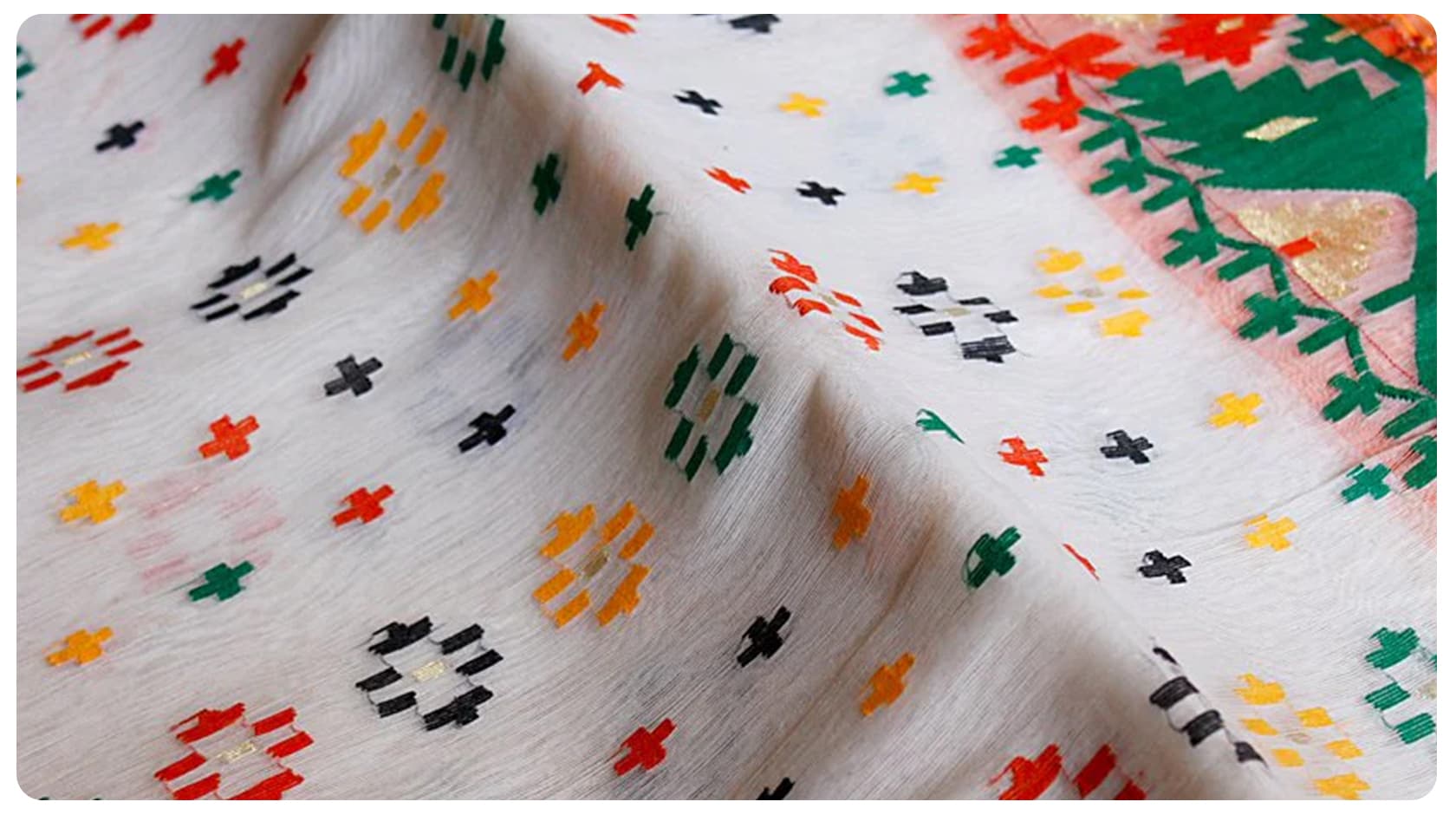

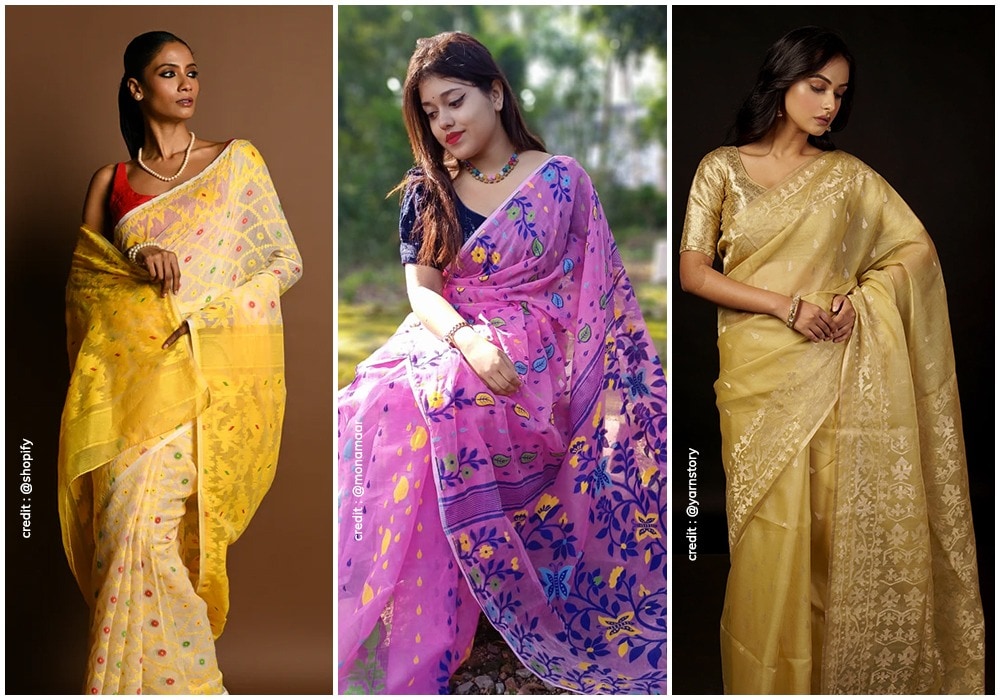
Imagine a fabric so light and airy it feels like wearing a cloud, yet so intricately patterned it looks like a painting. This is Jamdani, the legendary textile of Bengal. Often described as "woven air," Jamdani is not just a fabric; it is a labor of love, a masterpiece of manual skill, and one of the most advanced hand-weaving techniques in the world.
Originating from the historic regions of Bengal (now West Bengal and Bangladesh), this craft has survived the rise and fall of empires. From the royal courts of the Mughals to the runways of modern fashion weeks, Jamdani has remained a symbol of sophistication and cultural identity.
In this guide, we will unravel the delicate threads of Jamdani, exploring its ancient origins, the painstaking technique that makes it unique, and how this traditional craft is being reimagined for the modern world.
What is Jamdani?
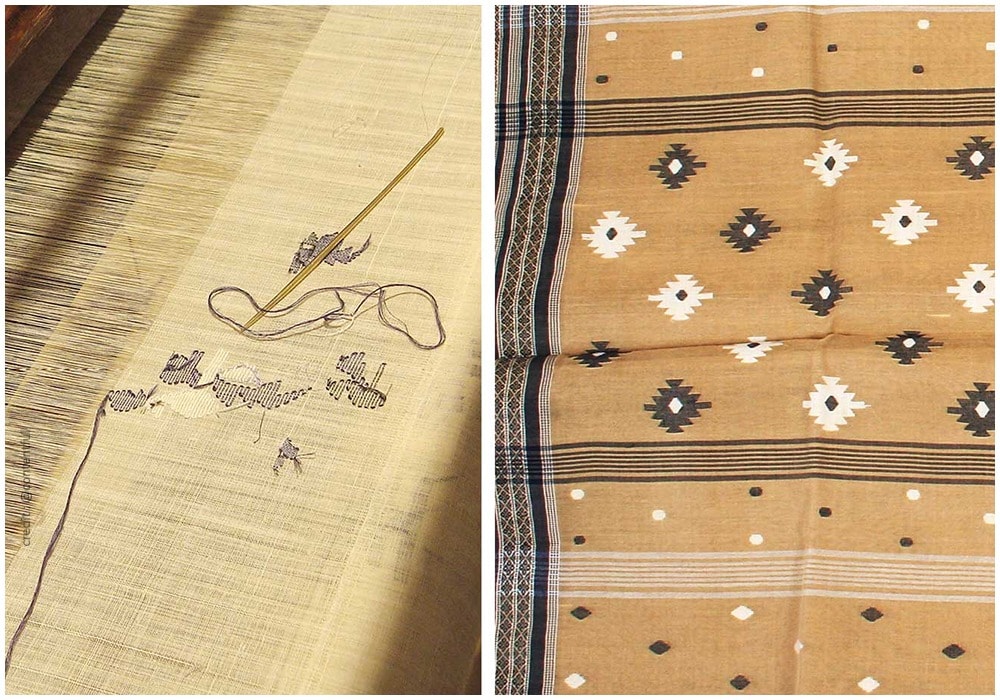
Jamdani is a hand-woven fabric made of high-quality cotton, historically known as muslin. What sets it apart is its unique weaving technique. Unlike printed fabrics where the design is stamped on top, or embroidered fabrics where the design is stitched after weaving, Jamdani patterns are woven directly into the fabric as it is being made.
This technique is often compared to tapestry work. The weaver uses a supplementary weft thread (often gold or colored cotton) to create intricate motifs that appear to float on the sheer, transparent background. The result is a textile that is incredibly lightweight yet rich in design—a perfect blend of simplicity and opulence.
Tracing the Origins: From Dhaka to the World
The story of Jamdani is as old as civilization itself. The earliest mentions of fine cloth from the Bengal region can be found in Chanakya’s Arthashastra, dating back to the 3rd century BC. Ancient travelers from Rome, China, and the Arab world also documented the existence of this exquisite textile.
The Mughal Influence
While the fabric existed earlier, the name "Jamdani" and its golden era blossomed under the Mughal Empire. The word is of Persian origin: Jam means "flower" and Dani means "vase." This name beautifully captures the essence of the craft, which is famous for its floral motifs.
The Mughals were great patrons of the arts, and they elevated Jamdani to a status symbol. During their rule, the finest muslins were produced in Dhaka (now the capital of Bangladesh). It is said that the fabric was so fine that an entire saree could pass through a small ring.
The Colonial Decline and Rebirth
The craft faced a dark period during British colonization. Policies favored industrial textiles from Europe, and the production of fine muslin suffered greatly. Cheap, machine-made imitations flooded the market, and artisans lost their royal patronage.
However, the spirit of the weaver could not be broken. After the partition of India, many weavers migrated from East Bengal to West Bengal (India), settling in districts like Nadia and Burdhaman. They carried their skills with them, leading to a revival of the craft on Indian soil. Today, Jamdani is a shared heritage, cherished on both sides of the border.
How It Is Made: The Discontinuous Weft Technique
The creation of a Jamdani saree is widely considered one of the most difficult and time-consuming weaving processes in the world. It requires the precision of a mathematician and the vision of an artist.
1. The Base Fabric
The process begins with unbleached cotton threads. The weaver sets up the loom to create a fine, sheer background fabric. This transparency is crucial, as it allows the motifs to stand out.
2. The Weaving Process
Here is where the magic happens. Jamdani uses a discontinuous weft technique.
- Standard Weft: The weaver throws the shuttle to create the base fabric.
- Supplementary Weft: For the design, the weaver uses a separate, thicker thread (often bleached or colored). Unlike a standard weft that goes all the way across the fabric, this thread is only inserted where the motif is needed.
- The Tool: The weaver uses a small, horn-shaped tool or a bamboo stick called a kandul to lift individual warp threads and manually interlace the design thread.
3. A Laborious Rhythm
The weaver must refer to a paper design placed underneath the warp threads (or memorize the pattern entirely). They weave the design thread by thread, row by row. Because the design thread doesn't run from edge to edge, the motifs look like they are floating on the fabric. A complex Jamdani saree can take anywhere from a few months to a whole year to complete.
Variations of the Craft
While the core technique remains the same, regional variations have developed over time, each with its own flavor.
Dhakai Jamdani
This is the original and most celebrated form, native to Bangladesh. It is known for its incredibly elaborate and fine weaves. These sarees are often heavy with intricate work and are considered the gold standard of Jamdani.
Tangail Jamdani
Woven in the Tangail district, this variation often features traditional borders with motifs like lotuses, lamps, and fish scales. It is known for its bold and attractive border designs.
Shantipur Jamdani
Hailing from Shantipur in West Bengal, this style is known for its fine texture. The designs often feature sophisticated stripes and are generally softer to the touch, making them comfortable for daily wear.
Dhaniakhali Jamdani
This variation has a tighter, denser weave compared to the others. It is known for bold colors and contrasting borders, making it more durable and structured than the finer muslins.
Design Elements and Motifs
Jamdani designs are a reflection of the weaver's environment and culture. The motifs are almost always geometric or floral, stylized to fit the grid of the weave.
- Butidar: The most common layout, where small floral sprays (butis) are scattered across the body of the saree.
- Tercha: Diagonal floral stripes that run across the fabric.
- Jhalar: A network of floral motifs that creates a border or a web-like pattern.
- Panna Hajar: Literally meaning "a thousand emeralds," this pattern is famous for its density, creating a shimmering effect.
Traditionally, the colors were muted—whites, off-whites, and greys. However, today’s Jamdani explodes with color, using bright hues and contrasting threads to appeal to modern tastes.
Jamdani Today: A Symbol of Identity
In 2013, the traditional art of Jamdani weaving was declared a UNESCO Intangible Cultural Heritage of Humanity. This recognition was a massive victory for the weavers who kept the tradition alive through centuries of struggle.
Modern Applications
Today, Jamdani has moved beyond just sarees. It is a versatile textile that has captured the imagination of global designers.
- Fashion: You can find Jamdani dresses, tunics, scarves, and even handkerchiefs. The breathability of the fabric makes it perfect for humid climates.
- Designer Collections: Top Indian designers like Rahul Mishra and Gaurang Shah have showcased Jamdani on international runways, proving that this ancient craft fits perfectly into contemporary luxury fashion.
- Home Decor: The sheer elegance of Jamdani is now being used for curtains, tablecloths, and cushion covers, adding a touch of heritage to modern homes.
Social Impact
The revival of Jamdani has restored pride in the weaver communities. Artisans who were once marginalized are now recognized as masters of a rare skill. Buying authentic Jamdani supports these families and ensures that this incredible knowledge is passed down to the next generation.
Conclusion
Jamdani is more than a textile; it is poetry woven in thread. It represents a history of resilience, a culture of artistry, and a future of sustainable fashion. In a world dominated by fast fashion and machine-made uniformity, Jamdani stands as a testament to the beauty of the human touch.
When you drape a Jamdani saree or wear a Jamdani scarf, you are wrapping yourself in history.

