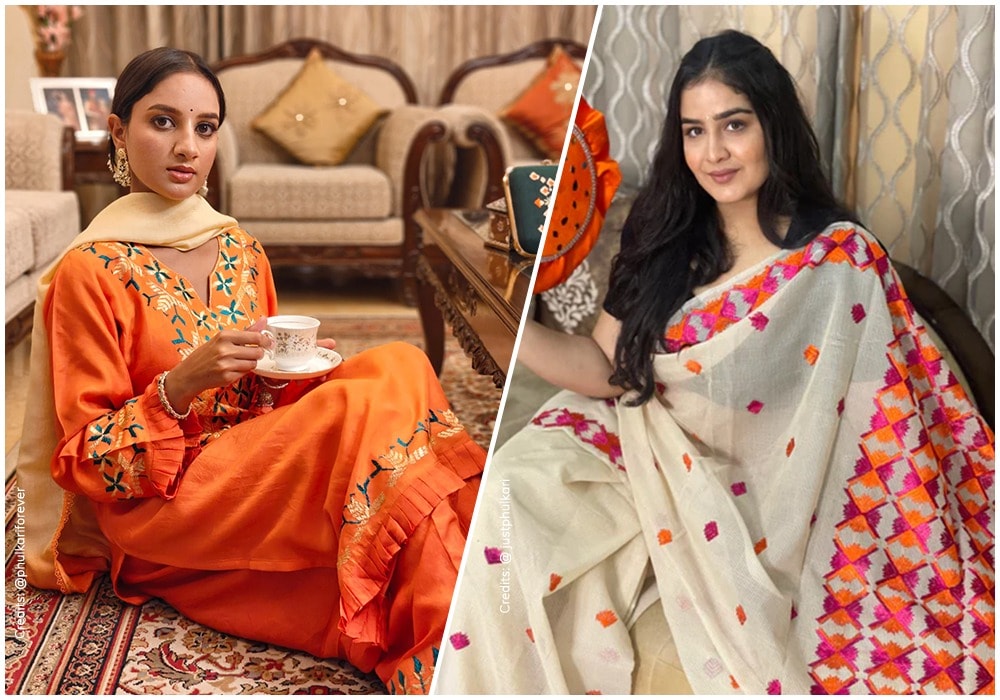
In the golden fields of Punjab, amidst the swaying wheat and the rhythm of folk songs, blooms an art form as vibrant as the land itself. This is Phulkari, a traditional embroidery style that literally translates to "flower work." More than just needle and thread, Phulkari is an emotion—a tapestry of dreams, love, and heritage woven by the women of Punjab.
From the tragic romance of Heer Ranjha to the auspicious trousseau of a new bride, Phulkari has been an integral part of Punjabi culture for centuries. It is a craft where geometric patterns and bright colors come together to create magic on coarse cotton fabric.
In this guide, we will thread our way through the history of Phulkari, uncover the secrets of its unique reverse-stitch technique, and explore how this rural craft has blossomed into a global fashion statement.
What is Phulkari?
Phulkari comes from two words: Phul meaning "flower" and Kari meaning "work." It is a folk embroidery tradition from Punjab (spanning both India and Pakistan) where colorful silk threads are used to create intricate patterns on a base of coarse cotton fabric known as khaddar.
Unlike other embroidery forms that might depict royal court scenes or religious figures, Phulkari is deeply rooted in everyday life. Its motifs are inspired by nature—sunflowers, jasmine, peacocks—and domestic surroundings. It is the art of the people, created by women for their families, often to mark the most important milestones of their lives.
Tracing the Origins: From Persia to Punjab
The history of Phulkari is stitched into the very folklore of the region. While its exact origins are debated, many historians believe the craft traveled from Iran, where a similar style called Gulkari (floral work) existed. It is thought to have been brought to India by migrating Jat tribes who settled in the northern plains.
Folklore and Literature
The craft is ancient enough to be mentioned in the Vedas and the Mahabharata. However, its most romantic connection is found in the 18th-century epic of Heer Ranjha by Waris Shah. In the story, the heroine Heer is described adorning beautiful Phulkari clothing, cementing the craft's place in Punjabi literary history. It is also referenced in the Guru Granth Sahib and countless folk songs, proving that Phulkari has always been more than just fabric—it is a cultural identifier.
How It Is Made: The Secret of the Wrong Side
The technique of Phulkari is unique and sets it apart from almost any other embroidery in the world.
1. The Darning Stitch
The most distinctive feature of Phulkari is the use of the darn stitch. Surprisingly, the embroidery is done from the wrong side (the back) of the fabric. The artisan counts the threads of the base fabric and passes the needle through to create the pattern on the front. This reverse technique requires immense skill and mathematical precision, as the design isn't drawn on the cloth beforehand.
2. The Thread and Fabric
- Pat: The thread used is an untwisted silk floss called Pat. Because the thread is untwisted, it reflects light brilliantly, giving the embroidery a luminous, soft sheen.
- Khaddar: The base fabric is traditionally khaddar, a coarse, hand-woven cotton. The rough texture of the cotton provides a sturdy base for the delicate silk threads.
3. A Domestic Craft
Traditionally, Phulkari was not a commercial activity. It was a domestic art practiced by women in their leisure time. Grandmothers and mothers would start embroidering Phulkari pieces (sometimes dozens of them) as soon as a girl was born, building a trousseau to be gifted at her wedding. A single elaborate piece could take up to a year to complete.
Variations of the Craft: More Than Just Flowers
While "flower work" is the general name, there are several specific types of Phulkari, each with its own purpose and design.
Bagh (Garden)
When the embroidery is so dense that it completely covers the base fabric, it is called a Bagh (meaning garden). In a Bagh, the geometric patterns are the main focus, and the base cloth is invisible.
- Panchranga Bagh: Decorated with five colors.
- Satranga Bagh: Decorated with seven colors.
Chope
This is a special Phulkari gifted by the maternal grandmother to the bride. It is embroidered in monochromatic golden-yellow or orange thread using a specific stitch that makes the design look identical on both sides. It is draped over the bride after her ritual bath on the wedding day.
Vari-Da Bagh
This type signifies the entry of the bride into her new home. It is gifted by the in-laws and is typically done on red khaddar with golden or orange geometric embroidery, symbolizing happiness and fertility.
Surajmukhi
Translating to "sunflower," this style features the main motif of a sunflower and is widely seen in daily-wear suits and dupattas.
Darshan Dwar
Meaning "The Gate of Vision," this rare variation was often made to be offered at temples (Gurudwaras). It features architectural motifs representing gates.
Symbolism and Cultural Significance
Phulkari is deeply symbolic of the lives of Punjabi women.
- Auspicious Beginnings: The birth of a girl child was celebrated by starting a new Phulkari. It represented the mother's love and hopes for her daughter's future.
- Colors of Life: The colors used are bold and expressive. Red symbolizes passion and marriage; yellow represents prosperity and the mustard fields of Punjab; blue and green reflect nature.
- Community Bonding: Women would often gather in groups to embroider together, singing folk songs and sharing stories. This turned the craft into a powerful tool for social bonding.
Notably, traditional Phulkari never includes religious icons or scenes of royal courts. It remained strictly secular and grounded in the reality of rural life.
Phulkari Today: A Global Blossom
Like many traditional crafts, Phulkari faced a decline with the advent of industrialization. However, its bold aesthetic and emotional resonance have ensured its survival and revival.
Modern Adaptations
Today, Phulkari has moved beyond the heavy khaddar shawls. You can find machine-made and hand-embroidered Phulkari on:
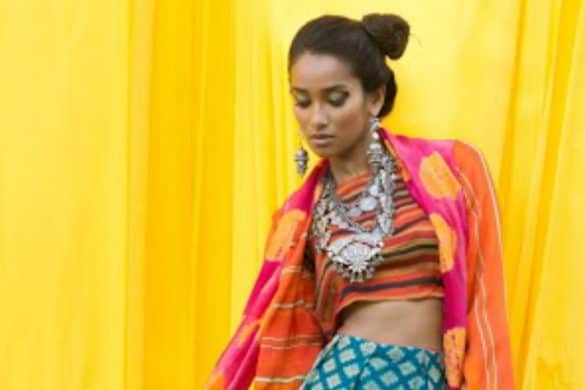
- Contemporary Fashion: Designers are using Phulkari motifs on jackets, stoles, handbags, and even shoes (juttis).
- Fabrics: While khaddar is traditional, modern Phulkari is done on lighter fabrics like chiffon, georgette, and crepe to suit modern silhouettes.
- Global Runways: Top Indian designers like Manish Malhotra have showcased Phulkari collections, bringing the vibrancy of Punjab to the global stage.
Preserving the Authenticity
While commercial production has made Phulkari widely available, there is a renewed interest in the authentic, hand-embroidered pieces. Efforts are being made to support the artisans who still practice the difficult thread-counting technique, ensuring that the true "flower work" doesn't fade into history.
Conclusion
Phulkari is a testament to the fact that art doesn't need a canvas; a piece of coarse cotton and a mother's love are enough. It weaves together the finesse of silk with the rustic charm of rural life.