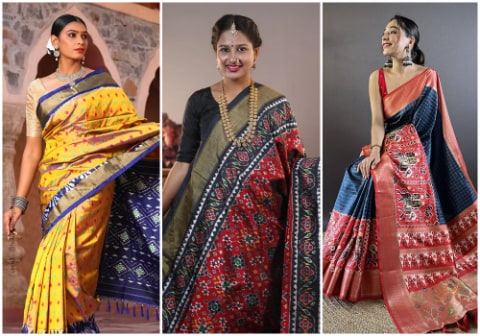
In the heart of Telangana, a state rich in history and craft, lies a small town that has woven its way onto the global map. This is Bhoodan Pochampally, the birthplace of the magnificent Pochampally Saree. Famous for its bold, geometric patterns and vibrant colors, the Pochampally is not just a garment; it is a masterpiece of mathematical precision and artistic vision.
What makes these sarees so mesmerizing is the unique Ikat technique used to create them. The patterns, characterized by their beautiful, diffused, or "hazy" edges, are a signature of this ancient craft. It is a visual style so unique that it captivates you, drawing you into its trance-like geometric world. This guide will take you through the story of the Pochampally saree, from its origins in the "Silk City of India" to its status as a prized possession in modern wardrobes.
What is a Pochampally Saree?
A Pochampally saree is a traditional handwoven saree made in Bhoodan Pochampally, Telangana. It is distinguished by its intricate geometric designs created using the Ikat style of dyeing. In this method, the threads are dyed before being woven, which requires incredible skill and foresight from the weaver. The patterns are not printed on the fabric but are woven into its very structure. This results in a design that is identical on both sides of the cloth.
Tracing the Origins: The Silk City of India
The history of Pochampally Ikat weaving dates back to the 1950s in the small town of Bhoodan Pochampally. While the broader tradition of Ikat weaving in India is ancient—with centers in Gujarat and Odisha—the craft in Pochampally gained momentum when local weavers were encouraged to create unique designs on cotton and silk. This initiative was aimed at boosting profitability and establishing a local identity.
The craft soon spread to neighboring villages, transforming the entire region into a hub of weaving excellence. Today, the area around Bhoodan Pochampally is home to a cluster of nearly 80 villages and over 10,000 weaving families, earning it the well-deserved title of the "Silk City of India." The skill has been passed down through generations, with families preserving patterns and techniques that are centuries old.
How It Is Made: The Art of Ikat Weaving
The creation of a Pochampally saree is a complex and painstaking process that showcases the weaver's genius. It is a perfect blend of art and mathematics. The term "Ikat" itself means "to tie" or "to bind."
1. Designing the Pattern
The process begins not on the loom, but on paper. The final design is first drawn onto graph paper. This graph acts as a blueprint for the entire dyeing process.
2. Tying the Yarns
Based on the design on the graph paper, the weaver takes bundles of silk or cotton yarn (the warp or weft threads) and tightly wraps sections of them with rubber strips or waterproof material. This is the "resist" part of the process.
3. Dyeing
The tied bundles of yarn are then dipped into vats of color. The wrapped sections resist the dye, remaining white, while the exposed parts absorb the color. For designs with multiple colors, this process of tying and dyeing is repeated for each new shade.
4. Weaving
This is where the magic truly unfolds. The dyed yarns, now carrying the pattern in segments, are carefully arranged on the loom. As the weaver interlaces the warp and weft threads, the pre-dyed segments align to form the intricate geometric patterns. The slight movement of threads during weaving is what creates the signature "feathery" or blurred edges of Ikat.
Variations of Pochampally Ikat
The complexity and value of a Pochampally saree are often determined by the type of Ikat technique used.
Single Ikat
In this technique, only one set of threads—either the warp (vertical threads) or the weft (horizontal threads)—is resist-dyed before weaving. The other set of threads is a solid color. Weaving the patterned threads with the plain ones creates the design. Weft Ikat is generally more complex and time-consuming than Warp Ikat because the weaver must constantly adjust the weft to align the pattern correctly.
Double Ikat
This is the most complex and expensive form of Ikat. Here, both the warp and the weft threads are resist-dyed separately. The weaver must then align both sets of patterned threads perfectly on the loom to form the final design. The level of skill required for Double Ikat is extraordinary, as even a slight misalignment can ruin the pattern.
Design Elements: Geometry and Inspiration
Pochampally sarees are celebrated for their bold, abstract, and geometric motifs. Unlike many other traditional Indian textiles that feature floral or figurative designs, Pochampally focuses on pure geometry.
- Geometric Shapes: You will find squares, diamonds, circles, and stripes arranged in intricate, repetitive patterns.
- Patola Influence: Some Pochampally designs draw inspiration from the famous Patola sarees of Gujarat. These may include stylized motifs like elephants, parrots, dancing figures, and flowers, but they are always contained within a strict geometric grid.
- The Telia Rumal: A classic and intricate design is the "Telia Rumal" (oily handkerchief). Historically, the yarns for this design were treated with oil, giving the fabric a unique texture and smell. It typically features bold geometric patterns in a red, black, and white color scheme.
Significance and Modern Relevance
The Pochampally saree is more than just a beautiful garment; it is a symbol of South Indian heritage and craftsmanship.
- A Wedding Staple: The richness of the silk, combined with the intricate handcrafted weave, makes Pochampally sarees a prized possession. They are an integral part of bridal trousseaus and are worn during important ceremonies and festivals in South India.
- Geographical Indication (GI) Status: To protect its authenticity and the livelihood of its weavers, Pochampally Ikat was granted a Geographical Indication (GI) tag in 2005. This ensures that only sarees woven in the designated region can be sold as genuine Pochampally.
- Global Recognition: The unique aesthetic of Pochampally has gained international acclaim. It is featured in fashion shows and exhibitions worldwide, and the fabric is used by designers to create contemporary clothing, accessories, and home furnishings.
Conclusion
The Pochampally saree is a testament to the enduring power of handcrafted excellence. Each saree is a canvas where a weaver's skill, patience, and artistic vision come to life. The geometric patterns, with their characteristic blurred edges, tell a story of a craft that has been perfected over generations.
By choosing a Pochampally saree, you are not just acquiring a piece of clothing; you are supporting a community of thousands of weavers and preserving a precious art form. It is a piece of the "Silk City" that you can drape, a timeless work of art that connects you to the rich textile legacy of India.