In the world of Indian sarees, few fabrics command as much respect and admiration as Mysore Silk. Known for its subtle, shimmering lustre and incredible softness, this fabric is more than just a piece of clothing—it is a piece of South Indian royalty. A genuine Mysore Silk saree is a prized possession, passed down through generations, and it never loses its shine.
But what makes this silk so special? Its story is a fascinating journey that involves visionary kings, Swiss machines, and a dedication to quality that has lasted for over a century. From the royal courts of the Kingdom of Mysore to the modern-day government-run factories, this is the story of a fabric that has truly stood the test of time.
Let's explore the regal history of Mysore Silk, understand the intricate process behind its creation, and see how this heritage is protected today.
What is Mysore Silk?
Mysore Silk is a high-quality silk fabric produced primarily in the state of Karnataka. It is famous for its unique characteristics:
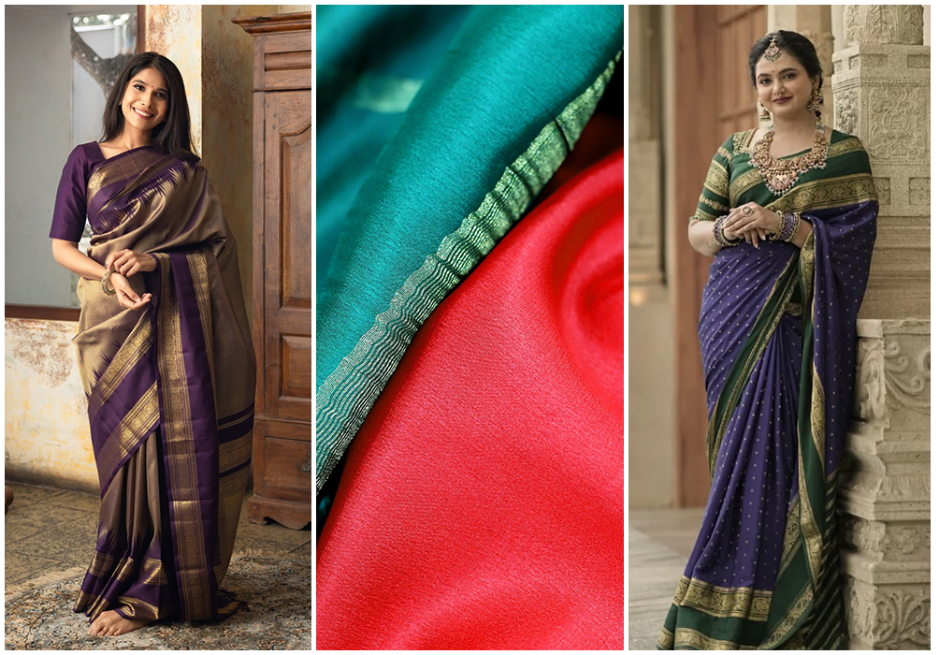
- Minimalist Design: Unlike other heavily decorated Indian silks, Mysore Silk sarees are known for their simplicity. They usually have a plain body with a contrasting, solid gold zari border.
- Unique Sheen: The silk has a natural, rich lustre that looks elegant and sophisticated.
- Durability: Made from pure silk and real zari threads, these sarees are incredibly long-lasting and maintain their shine for decades.
The production of genuine Mysore Silk is exclusively managed by the Karnataka Silk Industries Corporation Limited (KSIC), a government-owned enterprise. This ensures that every saree meets a very high standard of quality.
A Royal History: From Tipu Sultan to the Wodeyars
The story of Mysore Silk starts in the late 18th century with a ruler known for his vision and ambition: Tipu Sultan.
The Seeds Sown by Tipu Sultan
Around 1790, Tipu Sultan, the ruler of the Kingdom of Mysore, became fascinated with silk. He wanted to make Mysore a hub for silk production. He sent his men to Bengal and even as far as China to study sericulture (the process of raising silkworms) and bring back the best silkworms. He established breeding stations across his kingdom to begin local production.
However, after his reign, the industry saw a decline, especially with the rise of cheaper, imported fabrics like rayon in the 19th century. The ancestral tradition of silk weaving was at risk of being forgotten.
The Modern Factory under Maharaja Krishnaraja Wodeyar IV
The revival of Mysore Silk came in the early 20th century, thanks to Maharaja Krishnaraja Wodeyar IV. A progressive ruler, he wanted to modernize his state and preserve its heritage.
In 1912, after attending Queen Victoria's jubilee celebrations in Britain, he was impressed by the machine-made silk he saw there. He decided to bring this technology to Mysore. He ordered 32 power looms from Switzerland and established a state-of-the-art silk factory in Mysore. This was the first of its kind and marked the beginning of the modern Mysore Silk industry.
After India's independence, this factory was handed over to the government. Since 1980, it has been operated by KSIC. Today, KSIC is the sole producer of authentic Mysore Silk, and it is a Geographical Indication (GI) tagged product, meaning no one else can legally sell their fabric under this name.
The Making of a Masterpiece: How Mysore Silk is Made
Creating a Mysore Silk saree is a long and complex process that combines traditional knowledge with modern technology. It all starts with the humble silkworm.
1. From Cocoon to Thread
The journey begins in Ramanagara, a district near Mysore often called the "Silk City." Here, silk cocoons are sourced. The cocoons are first boiled in hot water. This softens them and makes it easy to extract the delicate silk filament. A single cocoon can yield a continuous thread that is hundreds of meters long. These fine threads are twisted together to create a stronger, more durable yarn. This twisting process gives the final fabric its signature crepe-like texture.
2. Weaving on the Loom
The twisted yarn is sent to the main weaving factory in Mysore. Here, artisans use power looms (either dobby or jacquard looms) to weave the fabric. The designs for the border and pallu are pre-programmed into the looms, but the process is closely monitored by skilled weavers. The zari used for the borders is made from pure silver threads electroplated with real gold, sourced from Surat in Gujarat. This is what gives the saree its authentic, lasting shimmer.
3. The Degumming Process
After weaving, the fabric has a rough texture. To make it smooth and soft, it goes through a process called degumming. Hundreds of sarees are soaked in boiling water mixed with soap and soda ash. This removes the natural gum (sericin) from the silk fibers, leaving the fabric incredibly soft and lustrous.
4. Dyeing and Finishing
The sarees are then dyed in large vats. The KSIC factory can produce sarees in over 300 colors, from deep purples and reds to subtle pastels. The colors are carefully chosen to complement the golden zari border. After dyeing, the sarees are steam-ironed in a large machine called a 'clip stentering' machine. This ensures the fabric is perfectly straight and wrinkle-free.
5. The Unique Identification Mark
This is the most crucial step for authenticity. Every single Mysore Silk saree is embroidered with a unique identification code. This stitched-in number allows customers to trace the saree's history and ensures they are buying a genuine product from KSIC. It is a powerful measure against fakes and duplicates.
6. Quality Check and Packaging
Finally, each saree is manually checked for any defects. Stains are removed, and extra threads are trimmed. Only after passing a strict quality control test is the saree packaged and sent to showrooms.
Mysore Silk Today: A Legacy Continues
The legacy of Tipu Sultan and the Wodeyars is alive and well. Mysore remains one of India's largest silk producers. The KSIC factory continues to innovate while protecting the tradition.
While the classic plain saree with a zari border remains the most iconic, Mysore Silk is now available in many varieties:
- Printed Sarees: Featuring beautiful floral or geometric prints.
- Crepe Silk: Known for its crinkled texture.
- Georgette Silk: A lighter, more translucent version.
- Tissue Silk: Woven with gold or silver threads to create a metallic sheen.
The fabric is also used to make other garments like kurtas, shirts, dhotis, and stoles, bringing its royal touch to more than just sarees.
The combination of pure silk, real gold zari, and a government-backed guarantee of authenticity makes Mysore Silk a symbol of luxury and trust. It represents a perfect blend of Karnataka's rich cultural history and modern technological precision.
Conclusion
A Mysore Silk saree is not just an outfit; it is an heirloom. It represents a centuries-old tradition that has been nurtured by kings and protected by a state. Its beauty lies in its simplicity, its value lies in its purity, and its charm lies in its timelessness.
In a world filled with fast-changing trends, Mysore Silk remains a constant—a reminder that true elegance never goes out of style. Owning one is like owning a piece of Indian history, woven with threads of gold and stories of kings.