


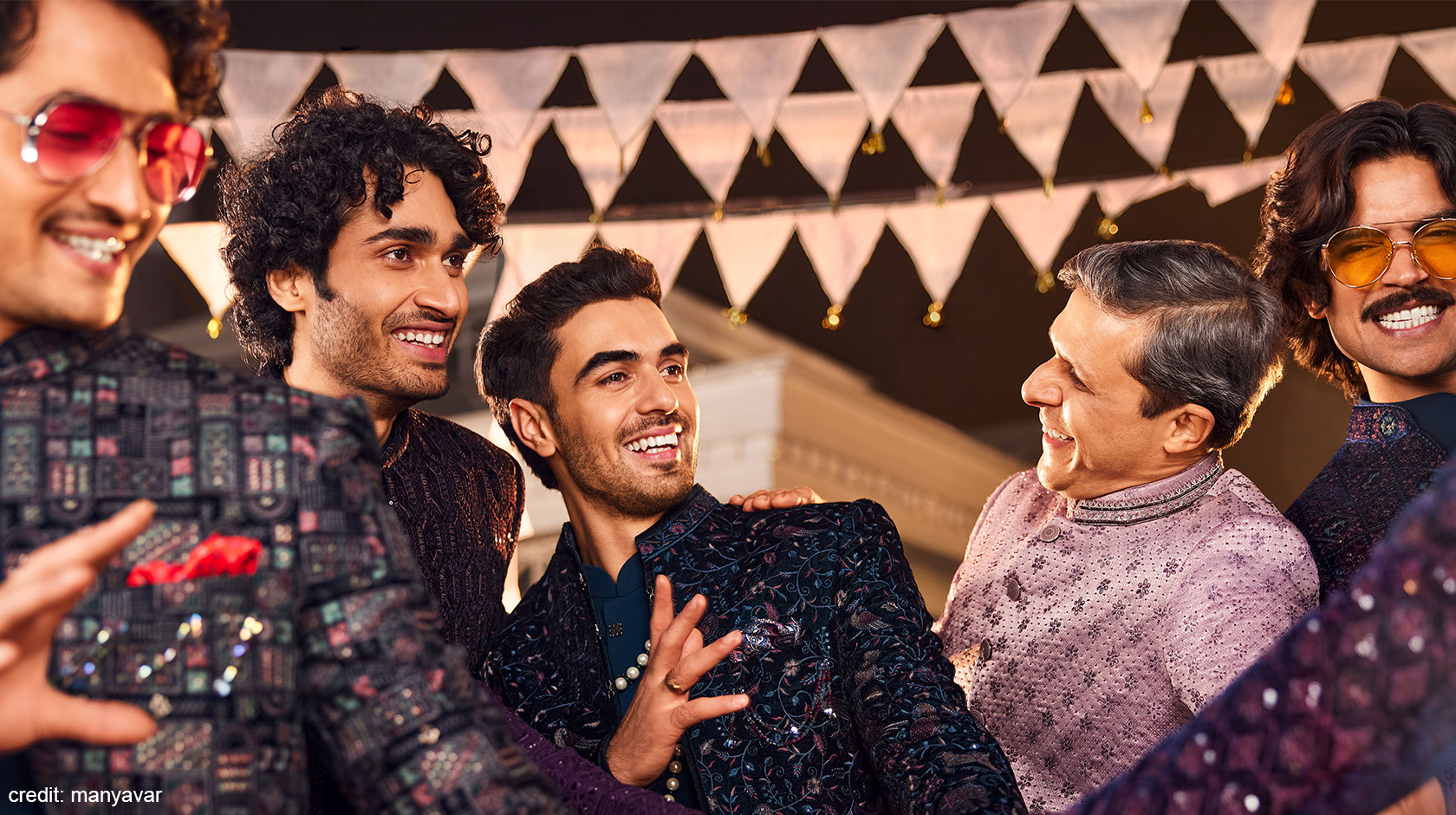
Fathers of the bride or groom should lean traditional and formal across all five functions—think silk kurta sets for daytime events, sherwanis for the ceremony, and bandhgalas for the reception. Brothers have more room to experiment, with embroidered kurta sets at Haldi and Mehendi, statement Indo-western looks at Sangeet, and rich silk or velvet options at the ceremony and reception. Avoid white and black as primary outfit colors.
You're not the groom—but every camera in the room will find you. The father of the bride or groom carries the weight of the occasion on his shoulders, while the brother walks the line between family formality and individual style.
Five functions. Two roles. Here's exactly what each one should wear.

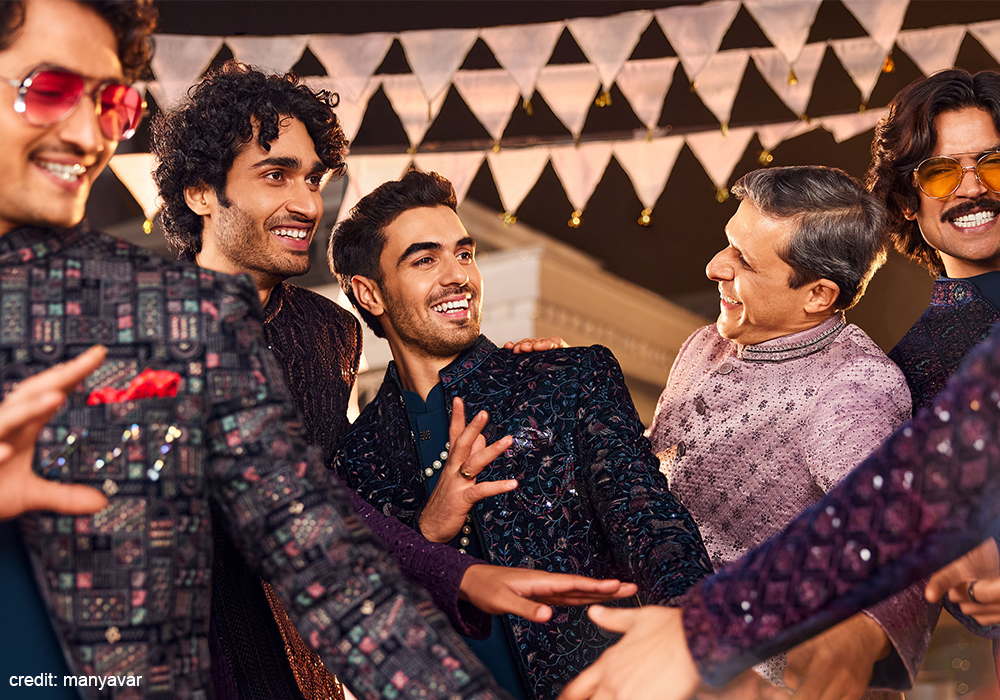
What should dads and brothers wear to the Haldi ceremony?
Haldi is casual by design. Turmeric will land on your clothes—plan accordingly.
For fathers: A simple cotton or linen kurta with straight-cut trousers works perfectly. Choose warm, earthy tones: saffron, turmeric yellow, sage green, or ivory. Skip embellishment entirely. This is a morning ritual, and the mood should match.
For brothers: This is a good moment for a printed kurta set or a relaxed co-ord in yellow, lime green, or rust. Lightweight fabrics like cotton or chanderi keep things comfortable during outdoor ceremonies.
Styling tip: Leave the heavy footwear at home. Kolhapuris or juttis are ideal for Haldi—easy to wear, easy to clean.
What should dads and brothers wear to the Mehendi function?
The Mehendi function marks the first real style moment of the wedding week. Color matters here.
For fathers: A well-fitted kurta set in a solid jewel tone—deep green, cobalt blue, or burgundy—strikes the right balance between festive and dignified. Opt for subtle texture over heavy embroidery. A Nehru collar or mandarin neck adds polish without effort.
For brothers: This is where fashion-forward choices work well. An embroidered or printed kurta with straight-cut or wide-leg trousers reads as intentional and contemporary. Deep marigold, terracotta, fuchsia, or forest green photograph beautifully under Mehendi decor.
Styling tip: Brothers can layer a structured Nehru jacket over a simple kurta to elevate the look without overdressing for a daytime function.
What should dads and brothers wear to the Sangeet?
The Sangeet calls for energy. The outfit needs to move.
For fathers: A sherwani in a rich tone—navy, wine, or deep teal—paired with churidar trousers is a strong choice. If a full sherwani feels like too much, a structured Nehru jacket over a kurta-churidar set achieves a similar level of formality.
For brothers: This is the function with the most creative latitude. A sequin-detailed kurta or an embroidered Indo-western jacket over slim trousers works well here. If you're performing at the Sangeet, prioritize movement—flared kurtas or relaxed fits will serve you better on stage than structured silhouettes.
Styling tip: Coordinate loosely with the broader family palette rather than matching outfits exactly. Aligning on a color family reads as cohesive in photographs without looking uniform.
What should dads and brothers wear to the wedding ceremony?
The ceremony is the most formal function on the schedule. Dress accordingly.
For fathers: A sherwani in silk, brocade, or raw silk is the most appropriate choice—and for most fathers, the most meaningful one. Rich tones like royal blue, deep maroon, forest green, and gold-tipped ivory all photograph beautifully. The craft matters here: zardozi or zari embroidery signals occasion dressing without requiring excessive coverage.
For brothers: A heavily embroidered sherwani in a jewel tone or a tailored Indo-western kurta set with brocade fabric both work well at the ceremony. If the brother is part of the baraat, lean toward something more traditional—this is a moment for the family to look unified.
Styling tip: Footwear matters at the ceremony. Embroidered juttis or mojaris finish a sherwani look the way the right shoes finish any outfit.
What should dads and brothers wear to the Reception?
The reception offers the most room to dress with personality—especially for brothers.
For fathers: A bandhgala suit in a deep, tailored fabric is a refined reception choice. Velvet, raw silk, and textured wool blends all carry the right level of formality. Deep navy, bottle green, or a warm charcoal work well without reading as too casual.
For brothers: A velvet or brocade bandhgala, a statement Indo-western jacket over well-fitted trousers, or a floor-length sherwani in a rich jewel tone—sapphire, emerald, deep plum—are all strong reception choices. If the venue is a hotel ballroom or formal banquet hall, dress to match the setting.
Styling tip: The reception is the right occasion for statement accessories. A pocket square, a brooch, or an embroidered dupatta can elevate a clean silhouette without adding bulk.
Fabric and color guidance for the men's family
A few principles that apply across all five functions:
- Avoid white and black as primary outfit colors. Both carry specific cultural significance or read as too casual for Indian wedding functions.
- For fathers, prioritize silk, brocade, and raw silk at formal functions. Cotton and linen work well at Haldi and Mehendi.
- For brothers, the same fabric hierarchy applies—but there's more room to incorporate contemporary cuts and Indo-western silhouettes, particularly at Sangeet and Reception.
- Coordinating with the women in the family on a color palette (not matching outfits) creates a cohesive family look in photographs.
Shop the men's wedding edit at Aza Fashions
Find outfits for every function at Aza Fashions:
Browse the full curated wedding edit at Celebration Closet or explore Just In for the latest arrivals.
Frequently Asked Questions
What is the difference between what a father and brother should wear to an Indian wedding?
Fathers generally dress more formally and traditionally across all five functions—sherwanis, silk kurtas, and bandhgalas are the standard. Brothers have more flexibility, especially at Sangeet and Reception, where Indo-western silhouettes, embroidered jackets, and fashion-forward choices are appropriate.
What colors should fathers and brothers avoid at an Indian wedding?
Avoid white and black as primary outfit colors. White is traditionally associated with mourning in some Indian cultural contexts, and black can read as too formal or inauspicious depending on the family's traditions. Both are best left out of the wedding wardrobe.
Do fathers and brothers need to coordinate outfits at an Indian wedding?
Exact matching is not necessary—and can look overly uniform in photographs. Loose coordination around a shared color family or palette is the more flattering and practical approach.
Is a sherwani necessary for the wedding ceremony?
A sherwani is the most traditional and widely accepted choice for the ceremony, but a tailored bandhgala suit or an embroidered kurta set in a ceremonial fabric are equally appropriate. The fabric and level of embellishment matter more than the silhouette.
What should a brother wear to the Sangeet if he is performing?
Prioritize silhouettes with freedom of movement—flared kurtas, relaxed Indo-western jackets, or wide-leg trousers. Heavily structured sherwanis or slim-cut bandhgalas are harder to perform in. Choose embellishment that photographs well under stage lighting, such as subtle sequin detail or tonal embroidery.

