

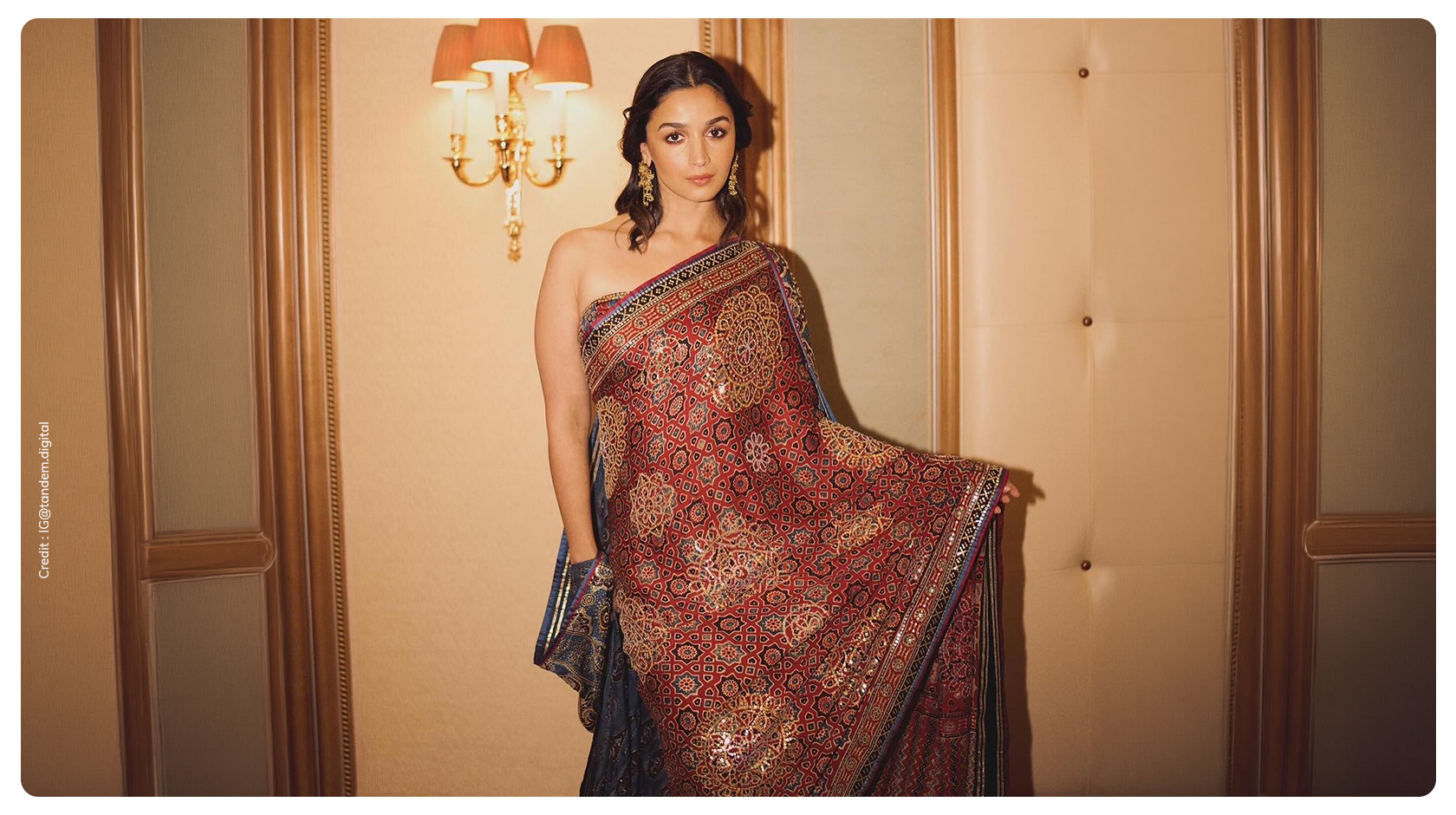
There's a reason your feed has been flooded with deep indigo and rust-red prints lately. Ajrakh, one of India's oldest surviving textile crafts, is having a full-blown red carpet moment. Before we get to the celebrity sightings, a quick note: Ajrakh is technically a hand block-printing and resist-dyeing technique, not an embroidery, though designers are increasingly pairing its geometric prints with sequin work, mirror embellishment, and zari to give it a more festive, embroidered finish. That fusion is exactly what's making it so covetable right now.
Where It All Began
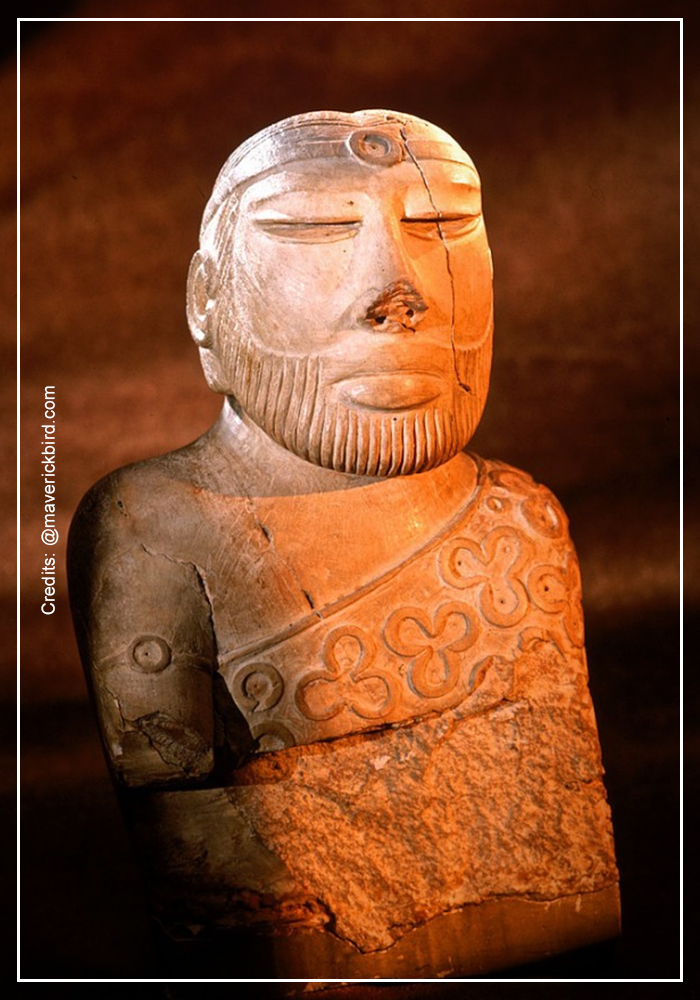
Ajrakh's story stretches back thousands of years, with many historians tracing its roots to the Indus Valley Civilization, where excavated textile fragments and dyeing techniques suggest an early tradition of patterned fabrics. Over centuries, the craft evolved and travelled to the Kutch region of Gujarat and Rajasthan's Barmer district from Sindh, in what is now Pakistan, around the 16th century.
It was carried by the Khatri community of printers and dyers, who settled along the banks of a river whose mineral rich water turned out to be essential to the process. The same families still practise the craft in Ajrakhpur today.

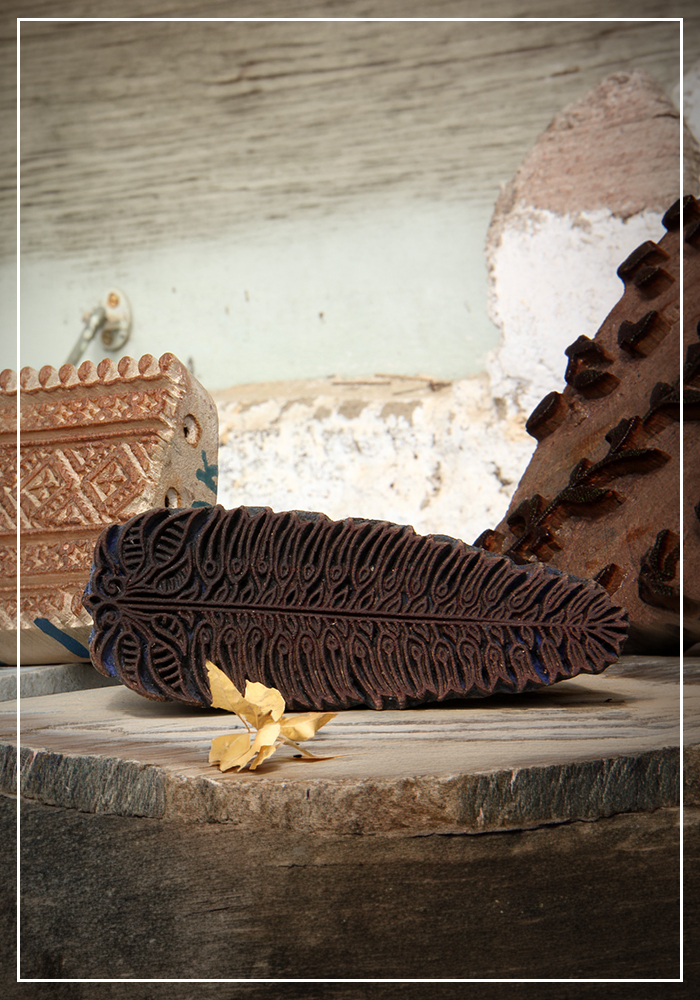
The name itself carries two possible stories. Some trace it to the Persian word azrak, meaning blue, a nod to the indigo that anchors every Ajrakh piece. Others link it to the Hindi phrase aaj rakh, meaning "keep it today", a reference to the patience the process demands, as the fabric rests between stages for days at a time.
For the pastoral Maldhari community, Ajrakh wasn't ceremonial wear. It was everyday cloth, turbans, lungis and shawls that doubled as baby cradles and night blankets. The patterns and colours were markers of identity long before they became fashion statements.
Interesting Facts That Make Ajrakh Worth Knowing
It's a 16-step process: From washing and treating the fabric with myrobalan to multiple rounds of resist-printing and dyeing, a single length of Ajrakh cloth can take up to three weeks to complete, entirely by hand.
The colours come from the earth: Indigo, madder root, pomegranate rind, and iron, every shade in an Ajrakh piece is drawn from natural sources, which is part of why the craft has become a poster child for sustainable fashion.

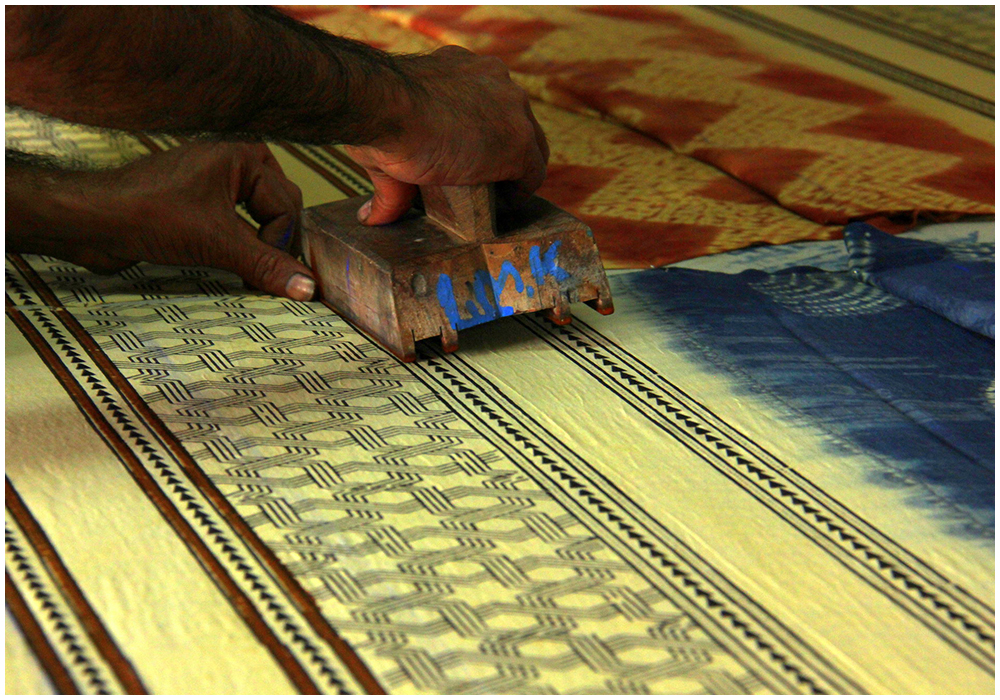
The patterns are mathematical: Ajrakh motifs are built on precise symmetry and repetition, geometric stars, florals, and lattice work so exact it borders on architectural.
It's a craft, not just a print: Genuine Ajrakh depends on the specific water and soil of the region it's made in, meaning the same block, used elsewhere, simply won't produce the same depth of colour.
Bollywood's Love Affair with Ajrakh
Once reserved for artisan communities, Ajrakh has found a devoted following among celebrities who continue to showcase its timeless appeal at weddings, festivals and global events.
Alia Bhatt Brings Ajrakh into the Spotlight
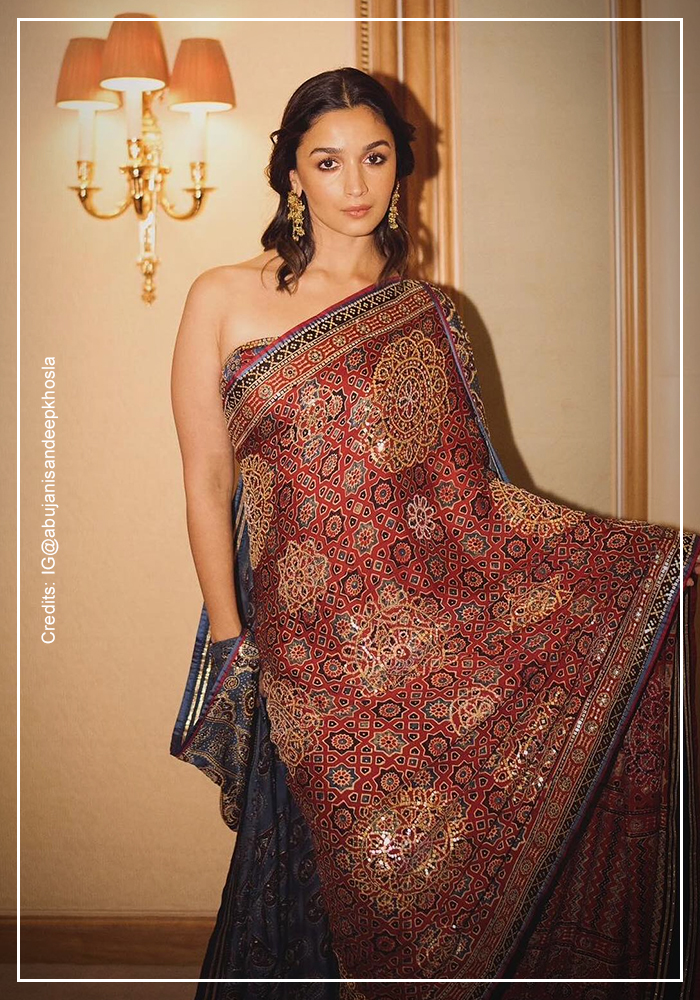
Alia Bhatt made a strong case for Ajrakh's red carpet potential at the Joy Awards in Riyadh, where she wore a red and indigo Ajrakh sari by Abu Jani Sandeep Khosla, styled with a strapless blouse and a flowing cape-like drape. The block-printed motifs did the talking, while subtle sequin detailing at the border added just enough shimmer for an award-night moment.
Sanya Malhotra Proves Ajrakh Is Celebration-Ready
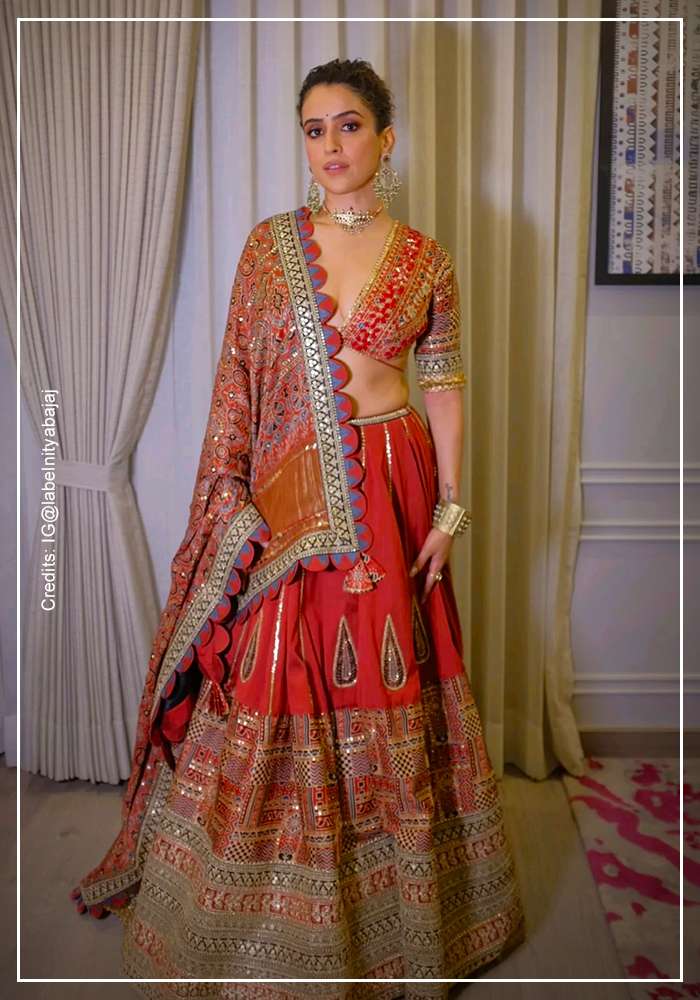
Sanya Malhotra took Ajrakh into full festive territory at a Navratri garba event in Ahmedabad, in a red lehenga with an Ajrakh blouse and an embellished odhani, proof that the print scales up beautifully from saree drapes to full lehenga sets without losing its identity.
Kriti Sanon Lets Ajrakh Shine
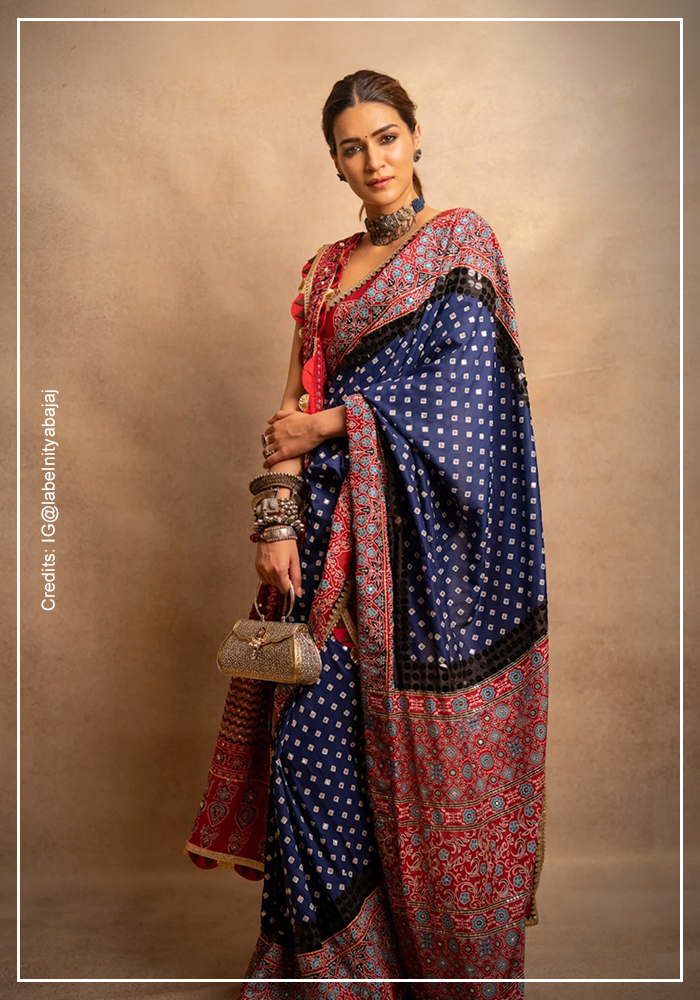
Kriti Sanon kept things closer to tradition in an Anita Dongre Ajrakh sari, letting the red-and-earth block print carry the look with almost no embellishment, a reminder that Ajrakh rarely needs help standing out.
From weddings and festivals to red carpets, Bollywood's leading ladies are proving that Ajrakh is as timeless as it is trend worthy.
Our Favourite Ajrakh Picks Right Now
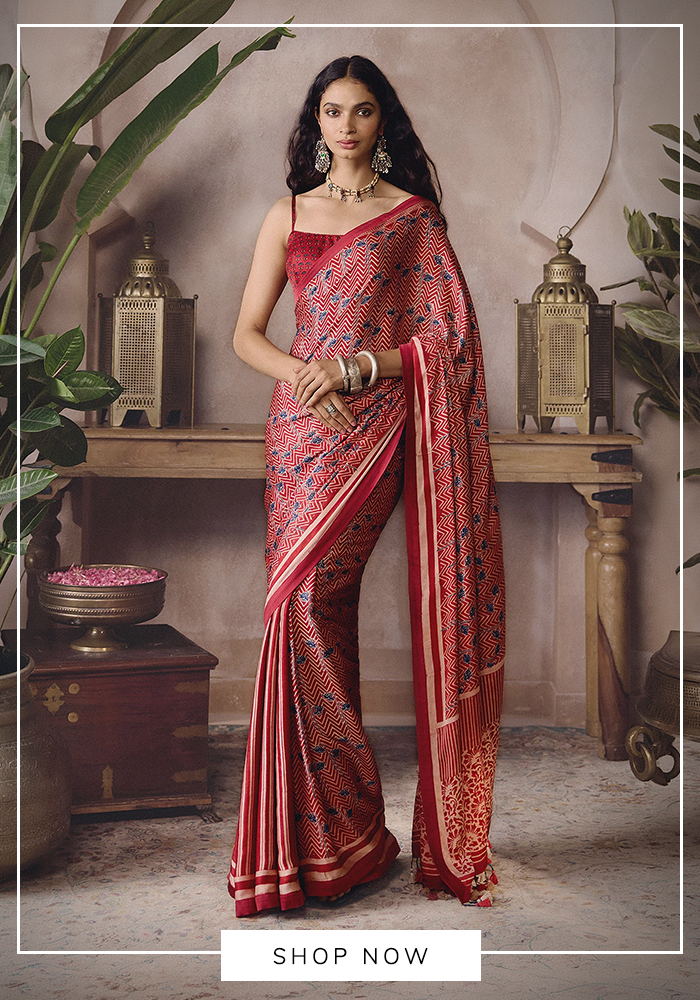
If Alia's red-and-indigo drama is more your speed, the Grassroots by Anita Dongre masterpiece does something similar in maroon modal satin, with a layered geometric print and a blouse finished in golden floral embroidery and mirror work, pre-draped, so the drama comes with zero effort.
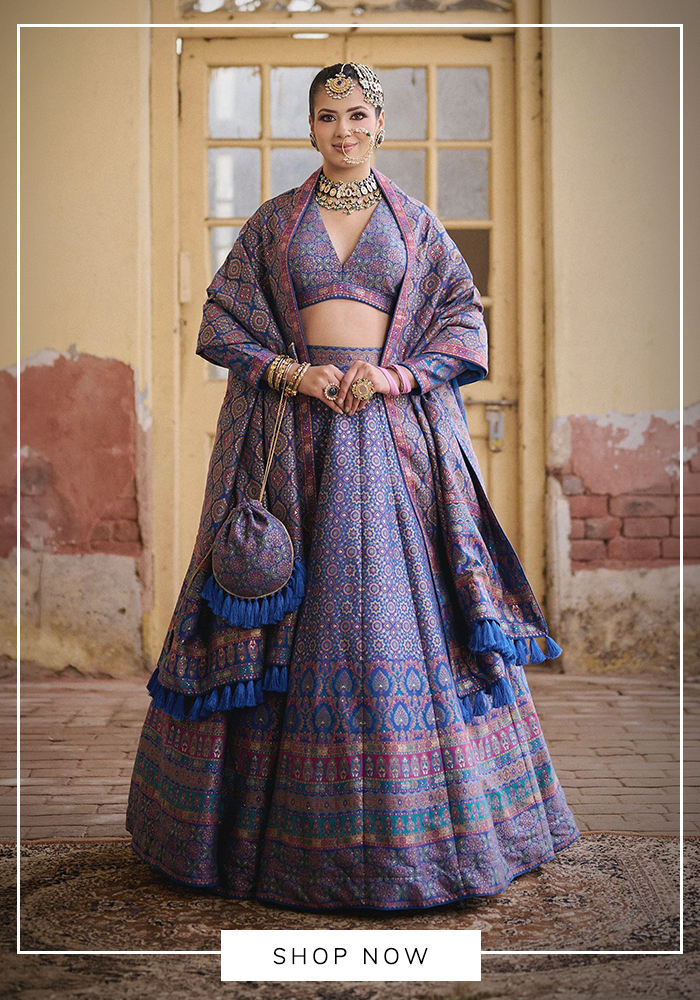
If you're thinking beyond sarees, the Safaa Kashni Ajrakh woven lehenga set brings the craft into bridal territory, proving that centuries-old block prints can feel just as striking on a modern wedding wardrobe.
Ajrakh has survived migration, mass production, and four centuries of changing fashion without losing its geometry or its soul — which might be exactly why Bollywood keeps reaching for it.
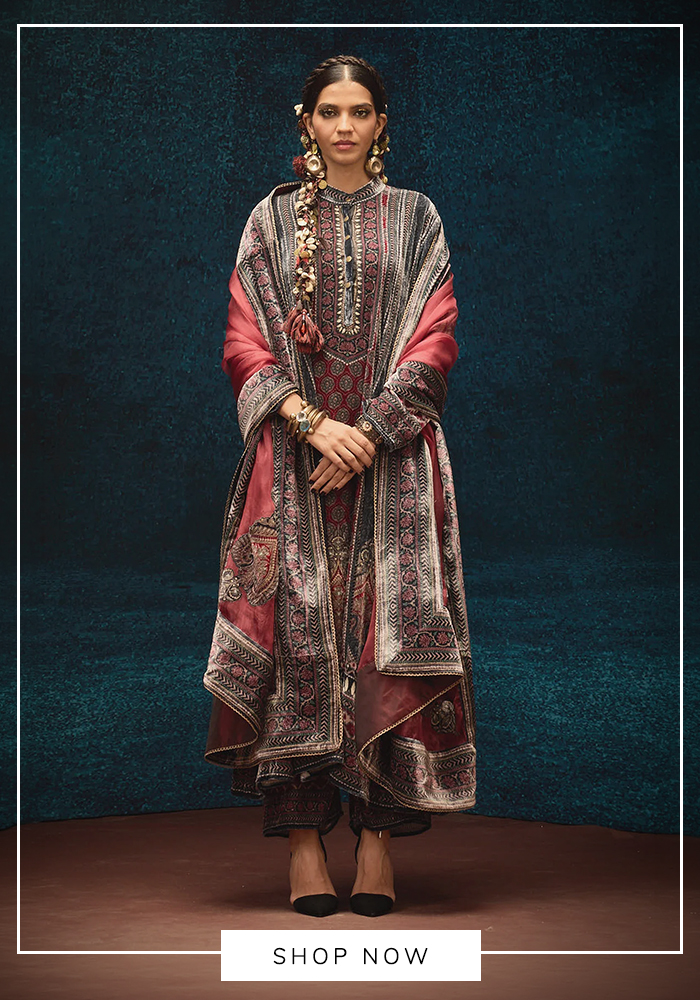
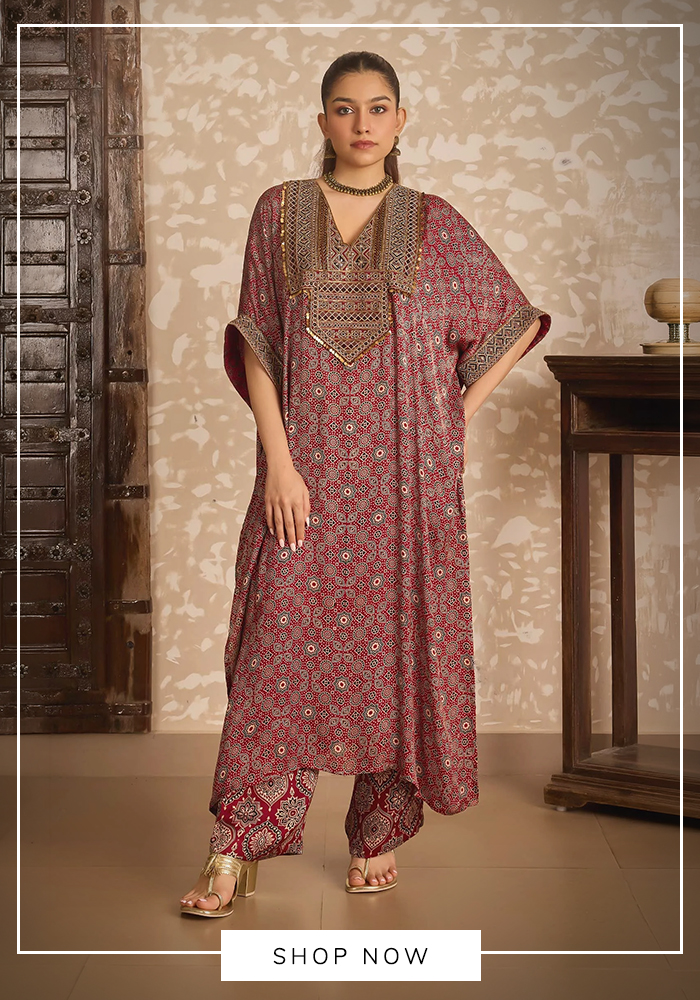
Ajrakh isn't stopping at occasion wear either. The Rajdeep Ranawat multi-colour Ajrakh print Anarkali refreshes the heritage print with vibrant hues, while Akashi Clothing's Ajrakh print kaftan and pant set makes it an effortless choice for destination holidays, festive brunches, or intimate celebrations.
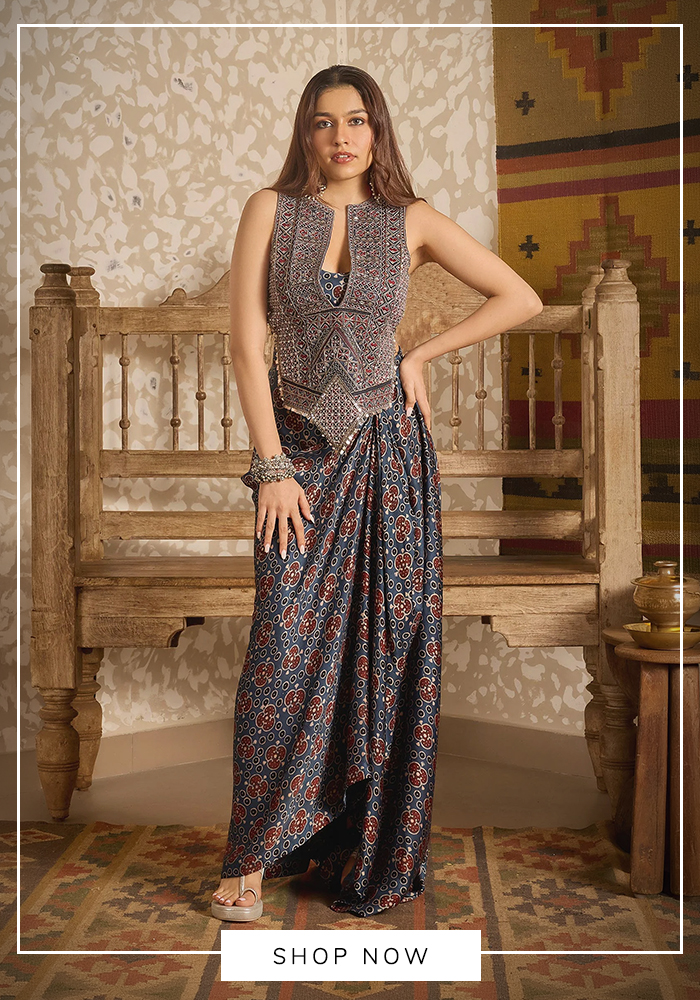
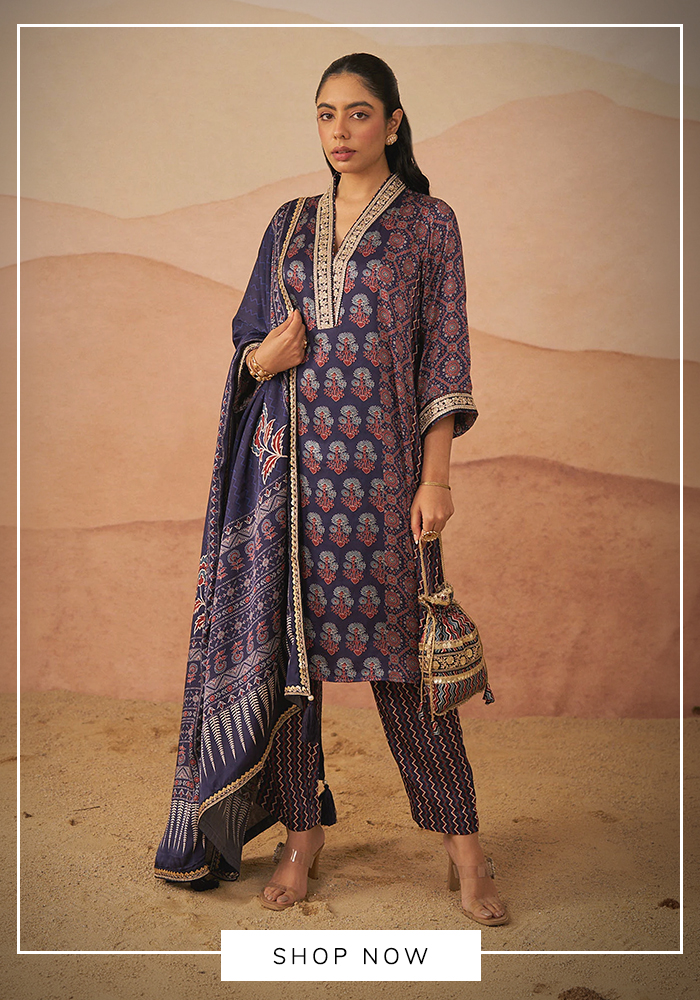
The label's Ajrakh print top and draped skirt set pushes things further into contemporary territory, showing how the craft slips naturally into fusion dressing. And for those who prefer everyday ethnic silhouettes, Rainas' geometric Ajrakh print kurta pant set offers an easy way to wear the timeless pattern long after the festive season is over.
Ajrakh has survived migration, mass production, and four centuries of changing fashion without losing its geometry or its soul, which might be exactly why Bollywood keeps reaching for it, and why designers continue finding fresh ways to reinterpret it for every kind of wardrobe.