West Bengal, a land of lush green landscapes and mighty rivers, is the cultural heartland of Eastern India. Its rich soil has cultivated not only bountiful harvests but also a profound literary and artistic heritage that has shaped the nation's intellectual discourse. From the poetic verses of Rabindranath Tagore to the cinematic genius of Satyajit Ray, Bengal has long been a cradle of creativity and thought. This deep-rooted artistic sensibility is beautifully reflected in its traditional clothing and iconic textiles.
The region's hot and humid climate naturally led to the mastery of lightweight, breathable fabrics, making its cotton and silk weaves legendary. At the same time, a history marked by royal patronage, social reforms, and a vibrant folk culture has nurtured some of India's most elegant and sophisticated textile crafts. Today, the understated grace of Bengali tradition continues to inspire modern fashion, offering a timeless aesthetic that blends simplicity with artistry.
Traditional Clothing / Ethnic Wear
Bengali attire is the epitome of elegance and intellectual charm. The clothing is designed with a sense of refined grace, emphasizing comfort and showcasing the region's exquisite weaving and embroidery traditions.
Women’s Attire
The saree is central to the identity of a Bengali woman, worn with a distinctive and graceful draping style.
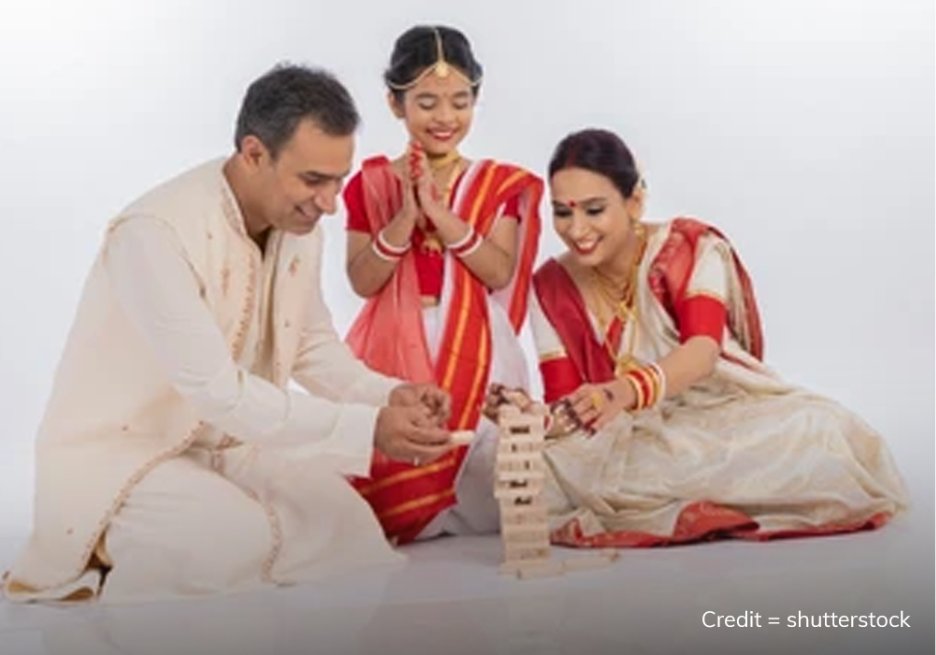
- The Bengali Saree: The classic Bengali drape is instantly recognizable. Worn without pleats at the front, the saree is wrapped around the waist and the pallu (the decorated end) is brought from the back over the left shoulder. For formal occasions, the pallu is often draped over the shoulder twice, with a decorative keychain (chabi'r gochha) attached.
- Tant Saree: The quintessential Bengali cotton saree, the tant is lightweight, crisp, and perfect for the humid climate. It features a thick border and a decorative pallu, woven with traditional motifs.
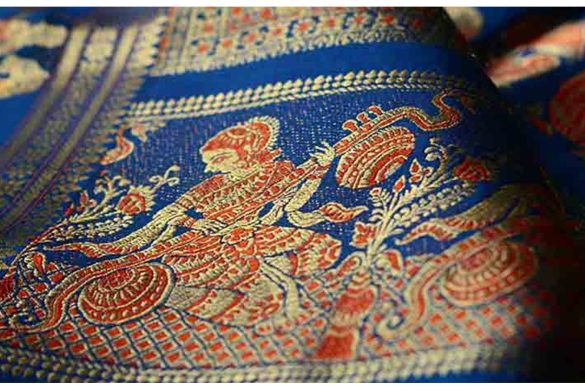
- Baluchari Saree: A rich silk saree from the town of Baluchar, it is famous for its intricate woven pallu depicting mythological scenes, royal courts, or social narratives.
- Garad Saree: This is a traditional silk saree with a stark white or off-white body and a simple red border. It is considered highly auspicious and is worn during religious ceremonies and festivals like Durga Puja.
Men’s Attire
The traditional attire for Bengali men is dignified and intellectual, reflecting a culture that values substance and simplicity.
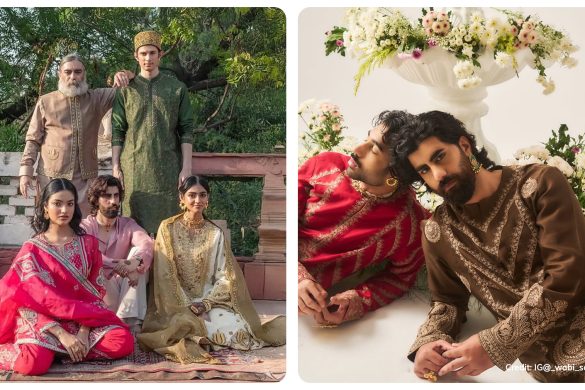
- Dhoti and Panjabi: The core outfit consists of a dhoti, a draped lower garment, and a panjabi, which is the Bengali term for a kurta. The panjabi is often made of cotton, silk, or tussar silk and can feature light embroidery (chikan) around the collar and buttons.
- Shawls: During cooler weather or for formal events, a shawl is draped over the panjabi, adding a layer of sophistication.
- Topor: For weddings, the groom wears a topor, a conical headgear made from shola pith (a milky-white sponge-wood). It is a symbol of auspiciousness and royalty.
- Jutti: While not exclusively Bengali, ornate leather juttis are often worn to complete the festive look.
Jewelry & Accessories
Bengali jewelry is deeply symbolic and is an essential part of the traditional look.
- Shakha-Pola: These are the most significant bangles for a married Bengali woman. The shakha is a white bangle made from conch shells, and the pola is a red bangle made from red coral. They are worn on each hand as a symbol of matrimony.
- Gold Ornaments: Bengali jewelers are known for their intricate gold craftsmanship. Traditional pieces include the kaan bala (ear cuffs), jhumko (bell-shaped earrings), and various necklaces like the sita haar (a long, multi-layered necklace).
- Hair Accessories: Ornate hairpins and fragrant flowers are often used to adorn a woman's hair bun, adding a final touch of grace.
Crafts, Textile Techniques & Prints
West Bengal’s textile heritage is defined by its handloom weaving and delicate embroidery, crafts that have been perfected over centuries.
- Kantha Embroidery: This is perhaps Bengal's most famous embroidery style. Traditionally, it was a way of upcycling old sarees and dhotis by stitching them together with a simple running stitch. Over time, it evolved into a sophisticated art form, with intricate motifs of flowers, animals, and scenes from daily life embroidered onto sarees, shawls, and home furnishings.
- Baluchari Weaving: Originating in Murshidabad, this technique uses supplementary weft threads to weave elaborate narrative scenes onto the borders and pallu of silk sarees. A single Baluchari saree can take weeks to weave.
- Tant Handloom Weaving: Woven primarily in the districts of Hooghly and Nadia, Tant sarees are starched to achieve a signature crispness. They are known for their lightness and transparency, making them ideal for the local climate. The weaving process requires immense skill to create the fine texture and intricate borders.
Cultural Context – Lifestyle, Tradition & Heritage Influences
The clothing of West Bengal is a direct reflection of its environment, history, and social ethos. The hot and humid climate makes lightweight, absorbent cotton the fabric of choice for daily wear. The loose-fitting panjabi and the airy drape of the saree are designed for comfort and ventilation.
Traditions of modesty are upheld through the graceful and full coverage of the saree drape. The white and red color combination of the Garad saree and Shakha-Pola bangles is deeply symbolic, representing purity and fertility, and is central to religious and cultural ceremonies.
Historically, Bengal was at the forefront of India’s intellectual awakening (the Bengal Renaissance) and the freedom movement. This fostered a culture that valued simplicity, intellect, and artistic expression over overt opulence, which is reflected in the elegant and often understated nature of its traditional attire. Patronage from zamindars (landowners) and nawabs helped crafts like Baluchari weaving flourish.
When & How These Styles Are Worn Today
Bengali styles, while deeply traditional, are versatile and very much a part of contemporary life.
- Everyday vs. Special Occasions: A crisp cotton Tant saree is still the preferred daily wear for many women in West Bengal. For special occasions like weddings and Durga Puja, women opt for magnificent Baluchari silks, ornate Jamdanis, or heavily embroidered Kantha sarees.
- Modern Reinterpretations: The panjabi has become a staple in men's ethnic fashion across India. Designers are using Kantha embroidery on modern silhouettes like jackets, dresses, and stoles. The motifs from Baluchari weaves are being printed on a variety of fabrics for contemporary wear.
- Styling Tips:
- Pair a simple Tant saree with a contemporary blouse and oxidized silver jewelry for a modern, artistic look.
- Use a Kantha embroidered scarf to add a touch of Bengali artistry to a simple kurta or even a western outfit.
- Men can style a classic white panjabi with jeans for a smart, Indo-western fusion look.
Why It Matters – Heritage, Identity & Fashion Inspiration
Preserving the textile crafts of West Bengal is about more than just maintaining an aesthetic; it is about protecting a profound cultural and artistic legacy. Each Kantha stitch tells a personal story, and every handwoven Tant saree represents the livelihood of an entire community of artisans.
In a world of fleeting trends, the enduring elegance and intellectual charm of Bengali style offer a powerful alternative. It inspires global fashion with its focus on craftsmanship, graceful silhouettes, and meaningful motifs. These traditions prove that true style is a blend of beauty, comfort, and cultural depth.
Experience the Soul of Bengal
West Bengal’s style heritage is a beautiful expression of art, literature, and life itself. From the poetic drape of a saree to the narrative threads of a Baluchari weave, each element speaks of a culture that celebrates intellect and elegance in equal measure.
We invite you to explore this world of refined grace. Consider adding a piece of Bengali craftsmanship to your wardrobe—be it a crisp Tant saree, a finely embroidered panjabi, or a beautiful Kantha stole. By doing so, you are not only embracing a timeless aesthetic but also supporting a rich artistic heritage that continues to enrich the fabric of India.