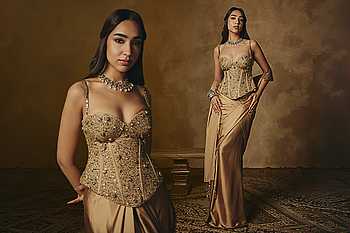
Dia Mirza - Aza Fashions Magazine

Dia Mirza

Challenges the Status Quo

Actor-producer, mother, and climate advocate Dia Mirza explores the contradictions of an evolving identity and a purpose that extends far beyond her profession, in conversation with Aza.
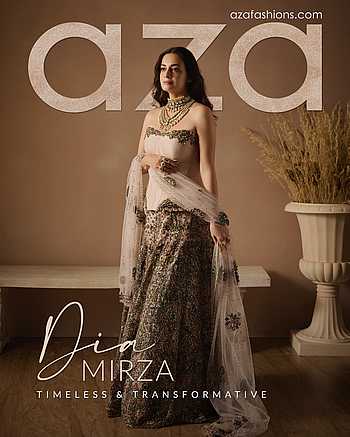
Outfits & Styling by Rocky Star; Photographs by Rohan Shrestha; Hair by Vithika Jaiswal; Makeup by Shraddha Mishra; Artist Reputation Management by Communique Film PR; Public Relations by Gulshan Singh; Words by Kajol Shah

More than two decades ago, before the films, the causes, the motherhood and the life lived in the public eye, a young Dia stood beneath the pageant lights and spoke of the values she believed in the most: honesty, love and friendship. When asked what beauty meant to her, she spoke not of features or appearances, but of strength of personality, grace, humility, love and care. Today, those words feel almost prescient. Because while the beauty queen became an actor, the actor became a producer, and the Bollywood figure evolved into a global voice for environmental advocacy as a UNEP Goodwill Ambassador for India and UN SDG Advocate, the values at her core have remained constant. What has changed is the definition of beauty itself.
Dia Mirza in Rocky Star
Shop the Look
Designer, Rocky Star; Jewellery, A Jewels by Anmol

BEAUTY WITH A CONSCIENCE

Dia arrives at the studio in what appears to be a handwoven shirt-and-trouser set, bare-faced, damp-haired and carrying the rosy aftermath of a post-workout glow. There is something of morning daisies, the smell of coffee, of nature itself about her. It is fitting, then, that her one request is that there be no plastic bottles in her changing room. “My definition of beauty has changed. For me, something cannot truly be beautiful if making it causes harm to people, animals or the planet.”

With organic produce, slow fashion, artisanal goods and beautifully designed reusable objects now defining the sustainability aesthetic, conscious living can seem like a luxury reserved for those who can afford it. Mirza counters that before sustainability became a buzzword, repair, reuse, seasonal eating and thrift were simply ways of life: “Many of the most sustainable ways of living in India have never been fashionable or expensive.” She pauses to acknowledge an acquaintance from another shoot, who is all praise for her work in the courtroom drama Ikka, then continues, “Our grandparents repaired things, reused containers, carried cloth bags, ate local and seasonal food, conserved water and wasted very little.”
quotes-img
My definition of beauty has changed. For me, something cannot truly be beautiful if making it causes harm to people, animals or the planet.

AGENCY ABOVE ALL

As Dia walks into the room, she is greeted with fresh flowers from Rocky Star, the man behind her exquisite outfits and styling for the cover shoot. Next comes a warm hug from photographer Rohan Shrestha, who shot Dia for Aza Magazine’s 10th issue a few years ago, and is capturing her through his unique lens once again. Soon, the room feels less like a set and more like a gathering of old friends. It is a fitting reminder of something Dia remembers fondly about the early years of her career. The unhurried intimacy of filmmaking, and the friendships that grew in the spaces between the scenes. Some of her closest friendships, she says, came from those years, including the people behind this collaboration. “There is history and trust. I have great admiration for Alka ma’am [founder of Aza] and for Rocky, for how they have built their businesses, for how much they value relationships and how much they care about quality.” “I miss the romance of it,” she tells me, as the trio disperses to kickstart the shoot preparations. “Months were spent together on outdoor schedules, travelling as a unit, eating together and waiting for the light. We were like family on set.”
quotes-img
There is history and trust. I have great admiration for Alka ma’am [founder of Aza] and for Rocky, for how they have built their businesses, for how much they value relationships and how much they care about quality.

What she does not romanticise, however, are the limitations that came with that era; the rigid hierarchies and the narrow ideas of what a heroine was supposed to look like, how she should behave, how old she could be and what stories she could carry. After the romantic leads of her early years, Dia gradually gravitated towards multi-cast films, character-driven stories and narratives with social relevance. Kaafir, Thappad, Bheed and Dhak Dhak belong to a different chapter of her filmography, one in which the question is less about being the face of a film and more about what the film has to say. Producing became another extension of that instinct. If acting allowed her to inhabit stories, her new production house 'One India Stories' allows her to have agency over which stories get made. Today, she sees more room for women to own their insecurities, ambition, flaws, anger, humour, sexuality and agency. And that expanded idea of womanhood informs the roles she wants to play now. “The role I want next is probably the one that scares me. I am less interested in whether a character is likeable and much more interested in whether she is truthful.” She goes on to explain how she’s inclined to play women who are “complicated, contradictory and perhaps even someone morally ambiguous” as that would require her to suspend judgment and find her humanity. That may explain why Dia sees age as an asset rather than an obstacle or endpoint.

LIKE FINE WINE

quotes-img
I feel far more equipped to play women now than I did in my twenties. Not because I know all the answers, but because I understand complexity better.

T-Bone Walker’s Stormy Monday plays in the background, while our muse stands on a stool in a beige, off-shoulder gown, looking almost Grecian. She points to her archival earrings, marvelling at their grandeur. “See how heavy they are, but stunning. These are 150-year-old earrings!” It’s an apt description of Dia’s relationship with time as well. “By forty, you have lived enough to understand that people are rarely just one thing. I feel far more equipped to play women now than I did in my twenties. Not because I know all the answers, but because I understand complexity better.”
Dia Mirza in Rocky Star
Shop the Look
Designer, Rocky Star; Jewellery, A Jewels by Anmol

A WOMAN OF MULTIPLICITIES

Her instinct to resist neat categorisation comes from much earlier. Raised amid different cultures, languages, traditions and faiths, Mirza says she grew up without experiencing them as mutually exclusive. Her identity, she believes, is made up of many influences. “My upbringing taught me that difference is not something to fear; it is something that can enlarge us.”
Dia Mirza in Rocky Star
Shop the Look
Designer, Rocky Star; Jewellery, Araiya by Aza
quotes-img
I hope we can raise kind, curious, courageous human beings

The plurality extends to her parenting style as well. She describes her parenting philosophy as “child-led”. She wants her children to feel heard and respected, to question, disagree and make mistakes, while understanding that freedom comes with responsibility. “More than raising ‘successful’ children,” she says, “I hope we can raise kind, curious, courageous human beings.“ She sets an example through her own choices by questioning inherited conventions. Dia married Vaibhav Rekhi in 2021 in an intimate ceremony officiated by female priest Sheela Atta. She chose not to participate in rituals such as kanyadaan and bidaai, quietly challenging the assumption that marriage must come packaged with a predetermined script.
Dia Mirza in Rocky Star
Shop the Look
Designer, Rocky Star; Jewellery, A Jewels by Anmol

There is a quiet coherence to it all. The former beauty queen questioning beauty. The actress questioning the narrow definition of a heroine. The woman questioning the idea that age diminishes relevance. The environmental advocate questioning a version of sustainability accessible only to the privileged. The mother thinking about what values are worth passing on.

After over two decades in the public eye, Dia Mirza is less interested in being one definitive thing than in allowing all her contradictions to coexist. And when there is finally nothing left to do, she tells us, she is happiest in simple moments — with her family, her plants, a book, a cup of tea, a walk, perhaps somewhere in nature. “Sometimes the healthiest thing you can do is simply be.” For someone whose life has been spent under the gaze of cameras, perhaps that is the most radical form of freedom. To be one with nature and to no longer need to perform an identity.

Get Insider Access

Follow us:

What's New at Aza Editorials

The stories, trends and style conversations defining the season.

Gold Outfit Colour Combinations

Gold Outfit Colour Combinations

The Future of Groomwear

The Future of Groomwear

Bridal Ear Cuffs Are In

Bridal Ear Cuffs Are In

Unique Blouse Designs

Unique Blouse Designs